March 2026 Full Moon: Your Complete Guide to the Worm Moon & Beyond
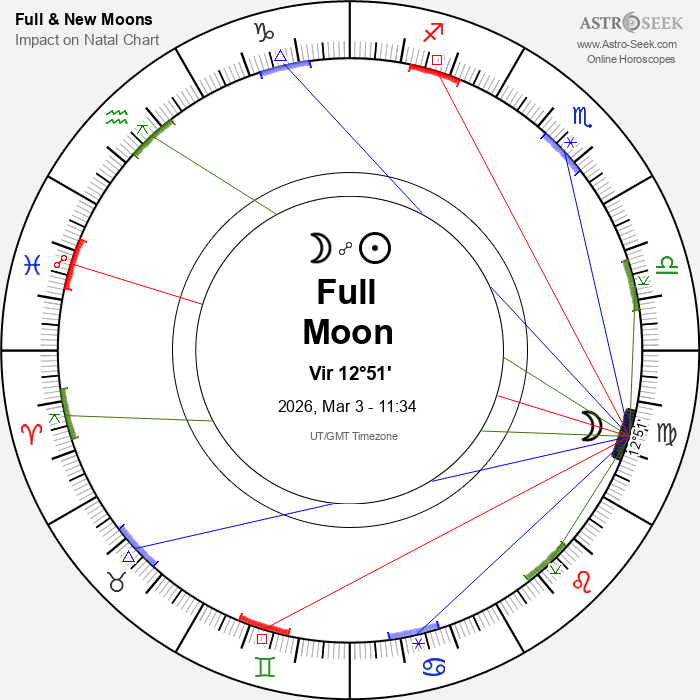
Mark your calendars, stargazers! The March 2026 Full Moon, known as the Worm Moon, will grace our skies on Tuesday, March 3, 2026. This particular full moon is a celestial event worth noting, not just for its beauty but also for an accompanying astronomical phenomenon: a total lunar eclipse. However, for those of us in the United States, that spectacular eclipse will remain hidden.
Still, even without the eclipse, March’s full moon offers a prime opportunity to connect with the cosmos. It marks a traditional turning point, as winter’s grip begins to loosen and the first signs of spring emerge.
The March 2026 Full Moon: Key Facts at a Glance
Let’s get straight to the essentials:
- Full Moon Name: The Worm Moon
- Date of Full Illumination: Tuesday, March 3, 2026
- Peak Illumination Time (UTC): 11:37 UTC
- Associated Celestial Event: A Total Lunar Eclipse (not visible from the USA)
- Significance: Symbolizes the transition from winter to spring, thawing grounds, and the return of earthworms.
While the total lunar eclipse will be a spectacle for those in Asia, Australia, and parts of Eastern Europe and Africa, we in the US will still enjoy the grandeur of a fully illuminated moon. Let’s make sure you know exactly when to look up.
When and Where to See the Worm Moon in the USA
Seeing the full moon isn’t just about knowing the date; it’s about understanding the precise moments of peak illumination and how your local time zone affects them. While the moon will appear full for about three days centered around March 3rd, hitting the peak illumination time can enhance your experience.

Peak Illumination Times Across US Time Zones
Here’s when the March 2026 Full Moon reaches its fullest phase, converted for major US time zones:
| Date | Peak Illumination (UTC) | Peak Illumination (EST) | Peak Illumination (CST) | Peak Illumination (MST) | Peak Illumination (PST) |
|---|---|---|---|---|---|
| Tuesday, March 3, 2026 | 11:37 AM UTC | 6:37 AM EST | 5:37 AM CST | 4:37 AM MST | 3:37 AM PST |
Keep in mind that these times are for the precise moment of 100% illumination. The moon will appear nearly full to the naked eye for a day or so before and after these times. For the best viewing experience, watch on the evening of Monday, March 2nd, and the evening of Tuesday, March 3rd, when the moon will be high in the sky after sunset.
Best Viewing Conditions & Practical Tips
While the full moon is undeniably bright and easy to spot, a few tips can enhance your experience:
- Find a Clear Horizon: Position yourself somewhere with an unobstructed view to the east (for moonrise) and west (for moonset).
- Minimize Light Pollution: Even a full moon is more breathtaking away from city lights. If you can, head to a park, rural area, or even your backyard if it’s relatively dark.
- Check the Weather: Clear skies are a must. Cloud cover can completely obscure your view.
- Naked Eye or Optics?: The full moon is stunning with the naked eye. However, binoculars or a small telescope will reveal fascinating details like craters and maria (dark plains) with incredible clarity.
- Dress Warmly: March evenings can still be chilly. Bundle up so you can comfortably enjoy the view for as long as you like.
Unpacking the “Worm Moon”: Origins and Meaning
Every full moon has a name, often rooted in the natural cycles and observations of ancient cultures. The March full moon, the Worm Moon, is particularly evocative of spring’s arrival.
Why “Worm Moon”? A Look at Its History
The name “Worm Moon” is widely attributed to Native American tribes, specifically those from the northern and eastern parts of what is now the United States. It refers to the time when the ground begins to thaw after winter, bringing earthworms (or “worm casts”) to the surface. This was a crucial sign that the soil was becoming workable, birds were returning, and the growing season was about to begin.
It’s a simple, elegant name that perfectly captures the subtle shift in nature from the barrenness of winter to the burgeoning life of spring. It’s a reminder of interconnectedness – the moon influencing tides, the sun warming the earth, and the smallest creatures signaling grand seasonal changes.
Alternative Names for the March Full Moon
While “Worm Moon” is the most common, different cultures and regions had their own ways of marking the March full moon, reflecting their local environments and livelihoods:
- Sap Moon: Some tribes, particularly those involved in maple sugaring, called it the Sap Moon, as this was the time of year when maple tree sap began to flow.
- Crow Moon: Named for the cawing of crows, signaling the end of winter.
- Crust Moon: Refers to the crust that forms on top of snow when it thaws by day and freezes at night.
- Lenten Moon: In some Christian traditions, the March full moon can coincide with the beginning of Lent, a period of fasting and prayer.
- Sugar Moon: Another name linked to the tapping of maple trees for syrup.
- Chaste Moon: A European name, symbolizing purity and new beginnings associated with spring.
These names are a beautiful testament to humanity’s long-standing connection to the lunar cycle and the rhythms of the natural world.
The Total Lunar Eclipse of March 2026: What You Need to Know
One of the most exciting aspects of the March 2026 Full Moon is its alignment with a total lunar eclipse. However, this is where geographic location becomes paramount.
Is the March 2026 Lunar Eclipse Visible in the USA? (Spoiler: No)
Sadly, for skywatchers in the United States, the total lunar eclipse on March 3, 2026, will not be visible. The timing of the eclipse means that North and South America will be facing away from the moon during the event.
The best visibility for this particular lunar eclipse will be across Asia, Australia, and parts of Eastern Europe and Africa. If you happen to have friends or family in those regions, tell them to look up!
Understanding a Total Lunar Eclipse
Even if we can’t see it, understanding what happens during a total lunar eclipse is fascinating. A lunar eclipse occurs when the Earth passes directly between the Sun and the Moon, casting a shadow on the Moon. Here’s a quick breakdown:
- Penumbral Eclipse: The Moon first passes through Earth’s faint outer shadow (penumbra). This is often barely noticeable.
- Partial Eclipse: The Moon then moves into Earth’s darker inner shadow (umbra), and a noticeable bite appears to be taken out of the Moon.
- Total Eclipse: The Moon is fully immersed in the Earth’s umbra. This is when the Moon often takes on a reddish or coppery hue, earning it the nickname “Blood Moon.”
The “Blood Moon” effect happens because some sunlight, filtered and refracted by Earth’s atmosphere, still reaches the moon. Blue light is scattered away more easily by our atmosphere (which is why the sky is blue), leaving red and orange light to bend around Earth and illuminate the moon. The exact shade of red can vary depending on dust and clouds in Earth’s atmosphere at the time of the eclipse.
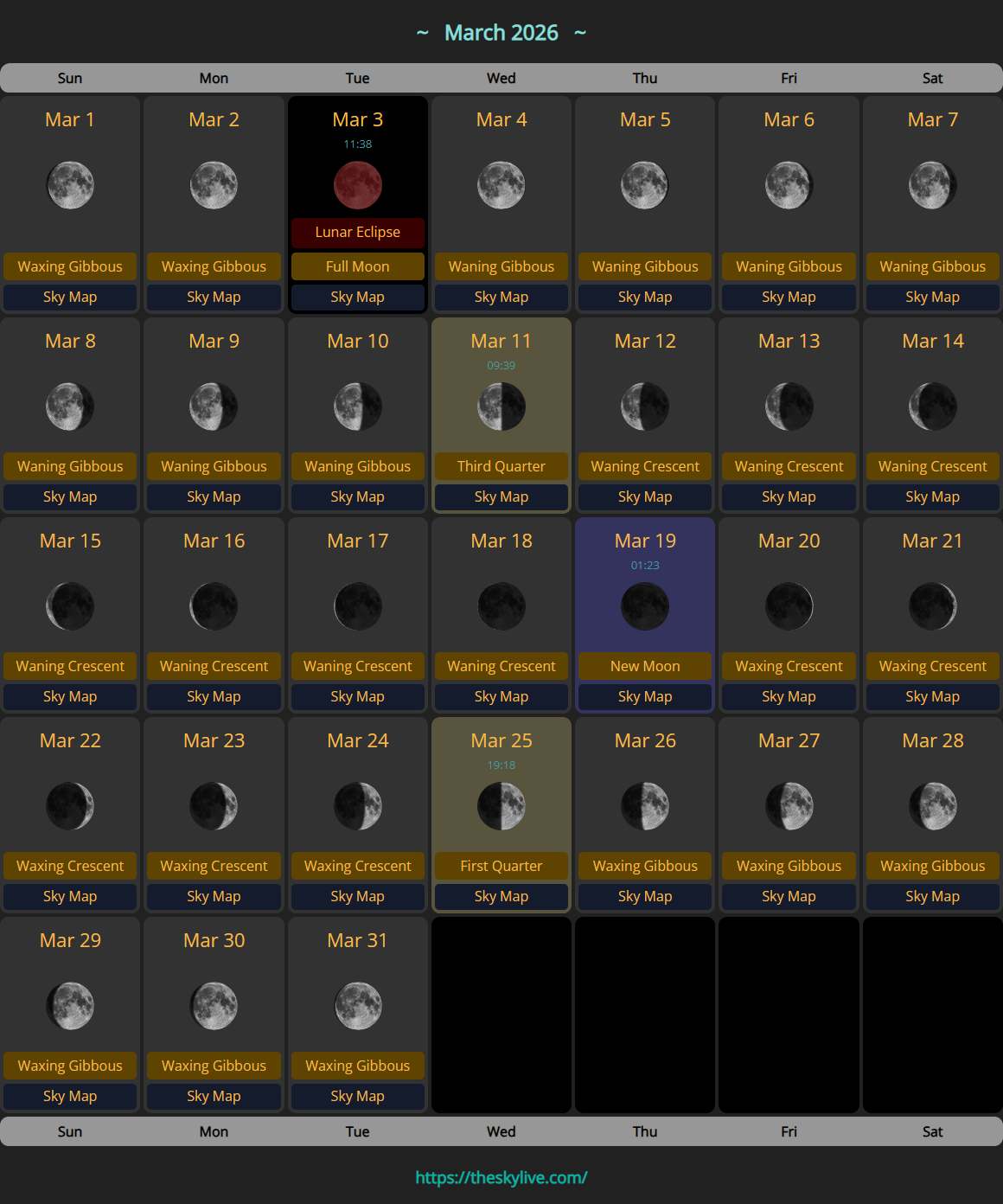
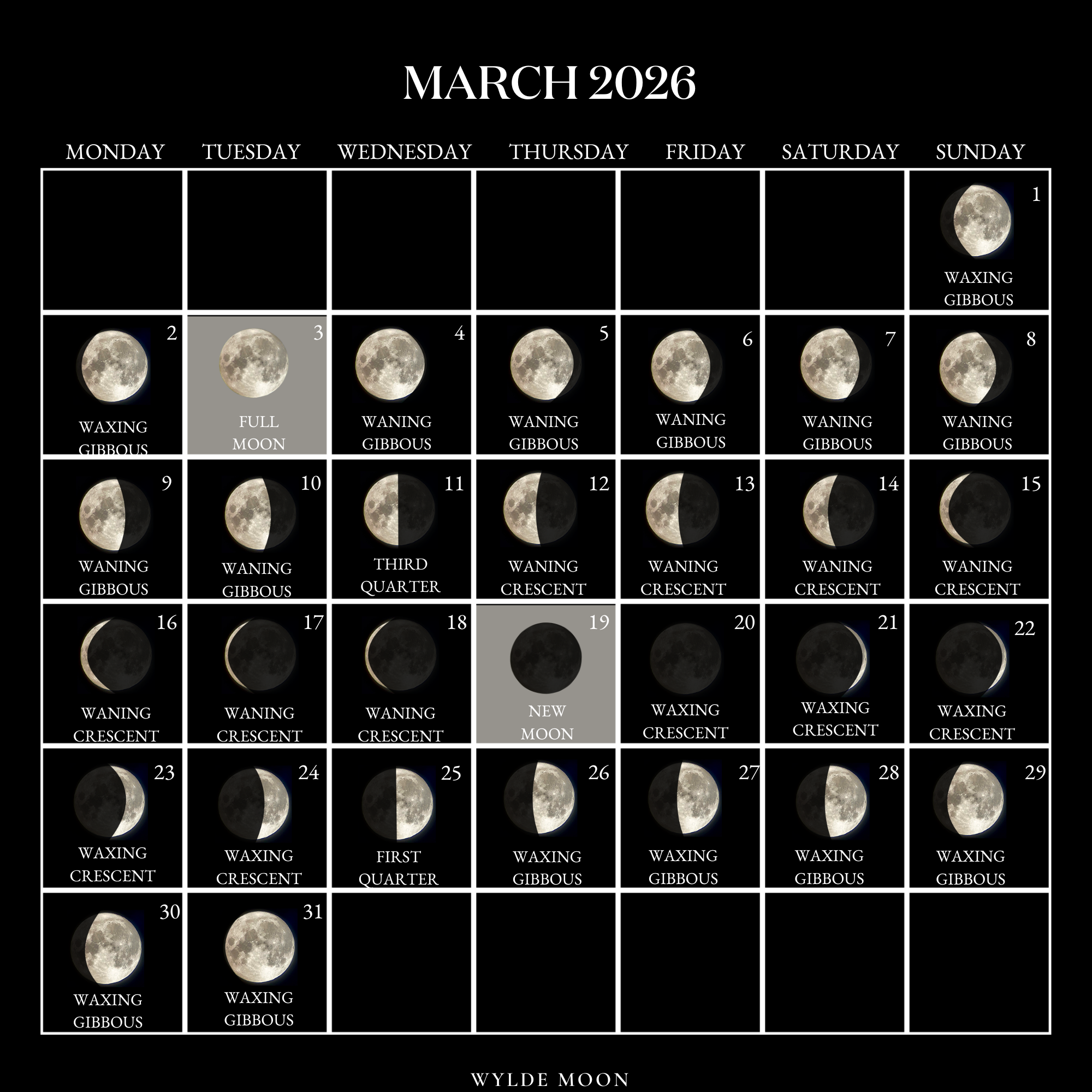
Full Moon Calendar for March 2026: All Phases Detailed
While the full moon gets all the glory, the moon goes through several distinct phases throughout March. Understanding these phases can enrich your appreciation for our celestial neighbor.
Here’s a detailed breakdown of the Moon Phases for March 2026, with times adjusted for US East Coast (EST) and West Coast (PST) for convenience:
| Date | Phase | Time (UTC) | Time (EST) | Time (PST) |
|---|---|---|---|---|
| Tuesday, March 3 | Full Moon (Worm Moon) | 11:37 AM | 6:37 AM | 3:37 AM |
| Wednesday, March 11 | Last Quarter Moon | 04:23 AM | Tuesday, Mar 10, 11:23 PM | Tuesday, Mar 10, 8:23 PM |
| Thursday, March 19 | New Moon | 00:30 AM | Wednesday, Mar 18, 7:30 PM | Wednesday, Mar 18, 4:30 PM |
| Thursday, March 26 | First Quarter Moon | 15:52 PM | 10:52 AM | 7:52 AM |
Understanding the lunar cycle can also be a wonderful way to track time, plan gardening, or simply appreciate the constant dance between Earth and its natural satellite.
What Else is Happening in the March 2026 Night Sky?
While the Worm Moon is undoubtedly the star of March 2026, the night sky often has other treats in store. March is a transition month, and as the nights shorten, the constellations shift.
- Spring Constellations Emerge: Look for classic spring constellations like Leo (the Lion), Virgo (the Maiden), and Ursa Major (the Big Dipper) climbing higher in the eastern sky after sunset.
- Planetary Sightings: Keep an eye out for any bright planets visible in the morning or evening twilight. Their positions change year-to-year, but March often offers good views of Venus or Jupiter at certain times. Check a reputable astronomy app or website closer to the date for precise planetary alignments.
- Subtle Meteor Showers: While March isn’t known for major meteor showers, there are sometimes minor ones like the Gamma Normids or the Virginids. These are usually faint and require very dark skies, but you might catch a stray shooting star if you’re patient and in a good viewing location.
No matter what else is happening, simply stepping outside and observing the night sky is a rewarding experience. The full moon provides a perfect starting point for your celestial exploration.
Looking Ahead: Full Moons in 2026
The March Worm Moon is just one of many lunar spectacles throughout 2026. Here’s a quick peek at the full moons scheduled for the rest of the year, providing a calendar for your future skywatching plans:
| Month | Full Moon Name | Date (Peak Illumination) |
|---|---|---|
| January | Wolf Moon | Saturday, January 3, 2026 |
| February | Snow Moon | Sunday, February 1, 2026 |
| March | Worm Moon | Tuesday, March 3, 2026 |
| April | Pink Moon | Wednesday, April 1, 2026 |
| May | Flower Moon | Friday, May 1, 2026 |
| June | Strawberry Moon | Saturday, May 30, 2026 |
| July | Buck Moon | Monday, July 27, 2026 |
| August | Sturgeon Moon | Wednesday, August 26, 2026 |
| September | Harvest Moon | Friday, September 25, 2026 |
| October | Hunter’s Moon | Sunday, October 25, 2026 |
| November | Beaver Moon | Monday, November 23, 2026 |
| December | Cold Moon | Wednesday, December 23, 2026 |
Each full moon throughout the year brings its own unique charm and cultural significance. Staying informed helps you plan your stargazing and deepen your connection with the night sky.
Final Thoughts: Embrace the Worm Moon
The March 2026 Worm Moon is more than just a date on a calendar; it’s a powerful symbol of renewal, growth, and the enduring beauty of our universe. Even without the lunar eclipse visibility for the US, the full moon itself is a magnificent sight. Take a moment on March 3rd (or the evenings around it) to step outside, look up, and appreciate this annual celestial visitor. It’s a simple, profound way to connect with the natural world and the vastness of space.
Frequently Asked Questions
When is the March 2026 Full Moon?
The March 2026 Full Moon, known as the Worm Moon, will reach peak illumination on Tuesday, March 3, 2026, at 11:37 AM UTC. This translates to 6:37 AM EST, 5:37 AM CST, 4:37 AM MST, and 3:37 AM PST.
Why is it called the Worm Moon?
The name ‘Worm Moon’ originates from Native American tribes. It signifies the time when the ground begins to thaw after winter, allowing earthworms to emerge and birds to return, marking the start of spring.
Will the March 2026 Lunar Eclipse be visible in the USA?
No, the total lunar eclipse associated with the March 2026 Full Moon will not be visible from the United States. It will primarily be visible across Asia, Australia, and parts of Eastern Europe and Africa.
What is a ‘Blood Moon’?
A ‘Blood Moon’ is a common term for a total lunar eclipse. During this event, the Moon turns a reddish or coppery hue because sunlight, filtered and refracted by Earth’s atmosphere, still reaches the Moon even though it’s fully within Earth’s shadow.

Are there other names for the March Full Moon?
Yes, besides Worm Moon, other traditional names include Sap Moon (for flowing maple sap), Crow Moon (for the return of crows), Crust Moon (for thawing/freezing snow), Lenten Moon, Sugar Moon, and Chaste Moon.
What are the best tips for viewing the March 2026 Full Moon?
For the best view, find a location with a clear horizon away from city lights, check the weather for clear skies, and consider using binoculars for a more detailed look. The moon will appear full for several nights around March 3rd, making the evenings of March 2nd and 3rd ideal for observation.