The March 2026 Full Moon: Date, Time, The Worm Moon & A Total Lunar Eclipse!
Get ready for a truly spectacular celestial event! March 2026 isn’t just bringing us another full moon; it’s delivering a rare and captivating show: a Total Lunar Eclipse. If you’re wondering when exactly to mark your calendar, here’s the essential intel:
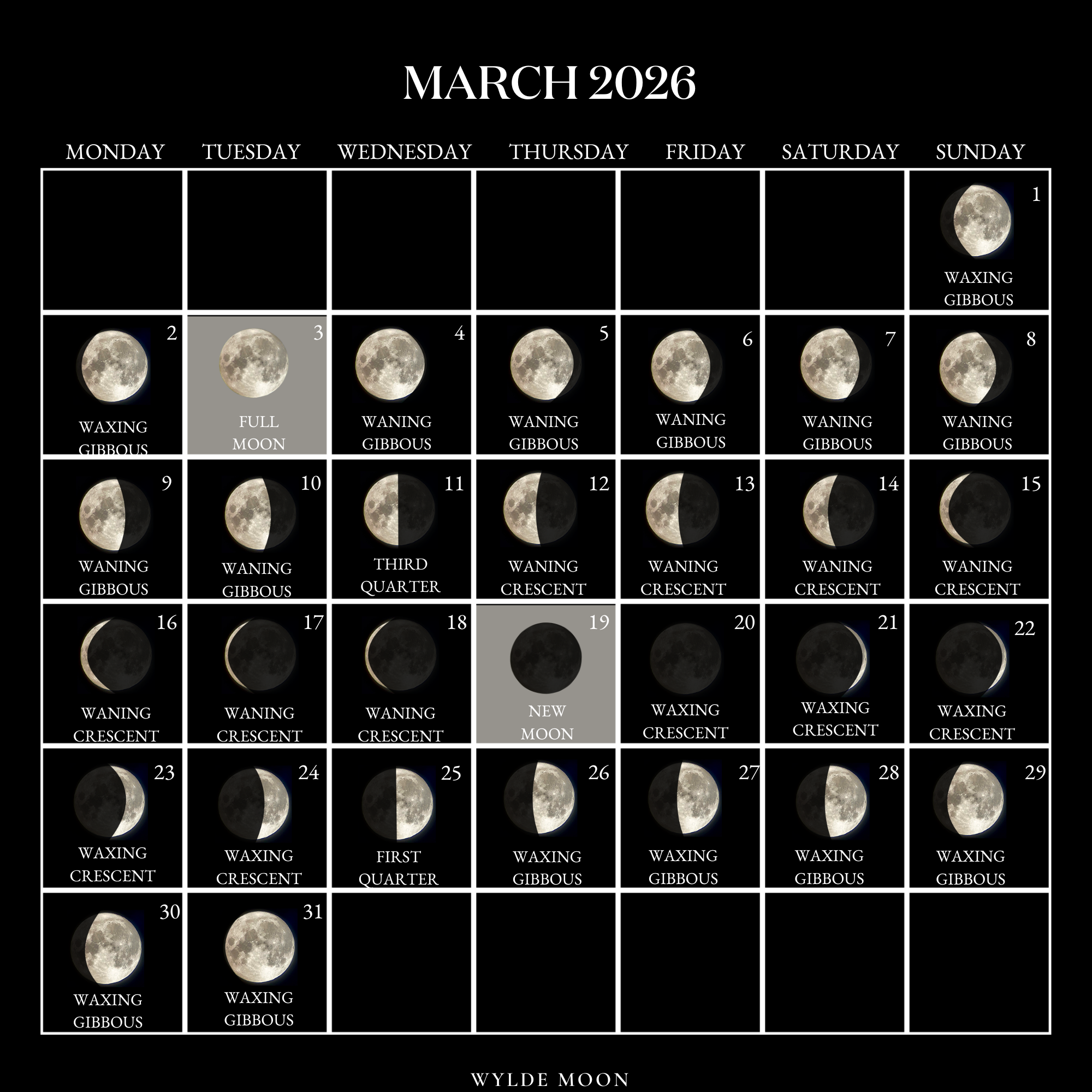
The Full Moon in March 2026, popularly known as the Worm Moon, will reach its peak illumination on Tuesday, March 3, 2026. But here’s the exciting part: during the early morning hours of that very day, the Moon will undergo a complete transformation, bathing in a reddish hue as it passes through Earth’s shadow. Yes, a ‘Blood Moon’ will grace our skies across the United States!
No need for special equipment, just your eyes and a sense of wonder. Let’s dive into all the details you need to experience this incredible cosmic dance.
When is the Full Moon in March 2026? Your Essential Details
Let’s cut right to the chase. You want the date, the time, and the name. Here it is, crystal clear, so you can plan your observation.
The Core Data: Date, Peak Illumination, & Name
The Full Moon officially reaches its fullest phase at 11:40 AM Universal Time (UT) on Tuesday, March 3, 2026. This might sound like a daytime event for many in the USA, and it is, but don’t fret – the magic of the full moon’s glow is evident the night before and the night after. More importantly, the total lunar eclipse occurs hours *before* this precise peak, while the Moon is still high in the sky for North America.
For those in the United States, here’s what that peak illumination time translates to:
| Location (USA) | Time Zone | Full Moon Peak (March 3, 2026) |
|---|---|---|
| Eastern USA | ET (UTC-5) | 6:40 AM |
| Central USA | CT (UTC-6) | 5:40 AM |
| Mountain USA | MT (UTC-7) | 4:40 AM |
| Pacific USA | PT (UTC-8) | 3:40 AM |
| Alaska | AKDT (UTC-9) | 2:40 AM |
| Hawaii | HST (UTC-10) | 1:40 AM |
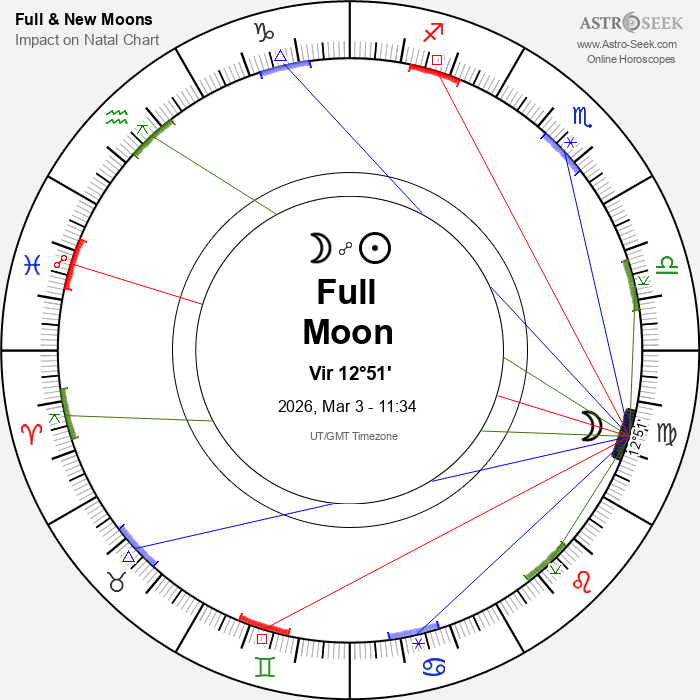
The traditional name for March’s full moon is the Worm Moon, a beautiful nod to the return of spring and the thawing earth. But this year, you’ll also hear it called a ‘Blood Moon’ due to the accompanying eclipse. Let’s explore that phenomenal event.

A Celestial Spectacle: The Total Lunar Eclipse of March 3, 2026
This isn’t just any full moon. The March 2026 Full Moon brings with it one of the most accessible and stunning celestial events: a Total Lunar Eclipse. This means our familiar bright moon will transform, taking on hues from deep orange to rusty red. It’s a truly mesmerizing sight that you won’t want to miss!
What is a Total Lunar Eclipse?
A lunar eclipse occurs when the Earth positions itself directly between the Sun and the Moon. When this happens, our planet casts a shadow onto the Moon. There are different types of lunar eclipses (penumbral, partial), but a total lunar eclipse is the most dramatic.
During a total eclipse, the Moon is completely engulfed by the darkest part of Earth’s shadow, known as the umbra. Instead of disappearing entirely, the Moon usually takes on a reddish-orange glow. Why? Because some sunlight, filtered and refracted by Earth’s atmosphere, still manages to reach the lunar surface. Think of it like all the sunsets and sunrises happening simultaneously around the edges of our planet, casting their light onto the Moon. This is why a total lunar eclipse is often referred to as a ‘Blood Moon’.
When and Where to See the March 2026 Lunar Eclipse in the USA
The fantastic news is that the entire continental United States will have a prime view of at least some, if not all, of the total lunar eclipse on March 3, 2026. For those in the Eastern and Central time zones, the totality will occur in the pre-dawn hours, making it an early morning spectacle. West Coasters will catch it even earlier in the night.
Here’s a breakdown of the key times for the eclipse phases, using Eastern Time (ET) as our primary reference. Remember to adjust for your local time zone.
| Eclipse Phase | Time (ET, March 3, 2026) | What to Expect |
|---|---|---|
| Penumbral Eclipse Begins | 1:41 AM | Moon enters Earth’s faint outer shadow. Subtle dimming, often hard to notice without careful observation. |
| Partial Eclipse Begins | 2:54 AM | Moon begins to enter Earth’s dark inner shadow (umbra). A noticeable ‘bite’ appears on the lunar disc. |
| Total Eclipse Begins | 4:00 AM | The Moon is completely within the umbra, glowing a reddish-orange. This is the ‘Blood Moon’ phase! |
| Maximum Eclipse | 4:40 AM | The deepest point of the eclipse, often the reddest and darkest. |
| Total Eclipse Ends | 5:21 AM | Moon begins to exit the umbra. The bright edge reappears. |
| Partial Eclipse Ends | 6:27 AM | Moon completely exits the umbra, returning to its brighter, but still somewhat dimmed, appearance. |
| Penumbral Eclipse Ends | 7:40 AM | Moon completely leaves Earth’s faint shadow. For most, the Moon will have set by this time. |
Important Note for Western USA: If you’re on the Pacific Coast, for example, subtract three hours from these ET times. So, the Total Eclipse begins at 1:00 AM PT and ends at 2:21 AM PT, providing a more convenient viewing window compared to the East Coast.
How to Safely Observe a Lunar Eclipse (No Special Gear Needed!)
Unlike solar eclipses, which require specialized eye protection, a lunar eclipse is completely safe to observe with the naked eye. The Moon’s light, even during totality, is not harmful.
Here are some tips for enjoying the March 2026 Blood Moon:
- Find a Clear View: Step outside to an area with an unobstructed view of the sky. The Moon will be quite high during the totality for most of the US.
- Bring Binoculars or a Telescope: While not essential, binoculars will greatly enhance your view, allowing you to see the subtle colors and textures on the lunar surface during the eclipse. A small telescope will provide an even more magnified and detailed look.
- Dress for the Weather: March mornings can be chilly, especially if you’re outside for an hour or more. Bundle up!
- Set an Alarm: Don’t miss the best part! Use the table above to set an alarm for the start of the partial or total eclipse in your timezone.
- Simply Enjoy: Sometimes the best way to observe is just to lie back (or sit in a comfy chair!) and watch the slow, mesmerizing transformation of our celestial neighbor.
Decoding the “Worm Moon”: History and Significance
Every full moon has its traditional name, often rooted in natural cycles and cultural observations. The March full moon, the ‘Worm Moon,’ is one of the most evocative, signaling a profound shift from winter’s dormancy to spring’s awakening.
The Origins of the Worm Moon Name
The name Worm Moon is widely attributed to Native American tribes, particularly those from the northern and eastern regions of North America, as well as early European settlers. It refers to the time of year when the ground begins to thaw after the long winter freeze. As the soil warms, earthworms (or ‘casting worms’) become active again, burrowing their way to the surface. This activity draws out birds, which begin to feed, and signals to humans that spring planting and fishing seasons are imminent.
It’s a beautiful, earthy name that connects us directly to the rhythms of nature. The Worm Moon isn’t just a date on a calendar; it’s an ancient reminder of renewal, growth, and the vibrant return of life after winter’s slumber.
Alternative Names for the March Full Moon
While ‘Worm Moon’ is the most popular, other cultures and regions had their own meaningful names for the March full moon, reflecting their unique observations of the changing season:

- Sap Moon: Used by some Native American tribes, this name refers to the time when maple sap begins to flow, making it perfect for tapping and producing maple syrup.
- Crow Moon: Another Indigenous American name, indicating the return of crows as winter recedes, signifying the end of cold weather.
- Lenten Moon: In Christian tradition, this name refers to the full moon that falls during the season of Lent, a period of fasting and reflection before Easter.
- Sugar Moon: Similar to the Sap Moon, this name highlights the harvesting of maple sugar.
- Chaste Moon: In some European traditions, this name symbolized purity and new beginnings.
These names underscore humanity’s long-standing connection to the lunar cycle as a natural calendar, guiding agricultural practices, hunting, and spiritual observances.
Beyond the Fullness: All March 2026 Moon Phases
While the Full Worm Moon and its accompanying eclipse are undoubtedly the highlights, the Moon cycles through all its phases in March 2026. Understanding the entire lunar calendar can enrich your connection to the night sky.
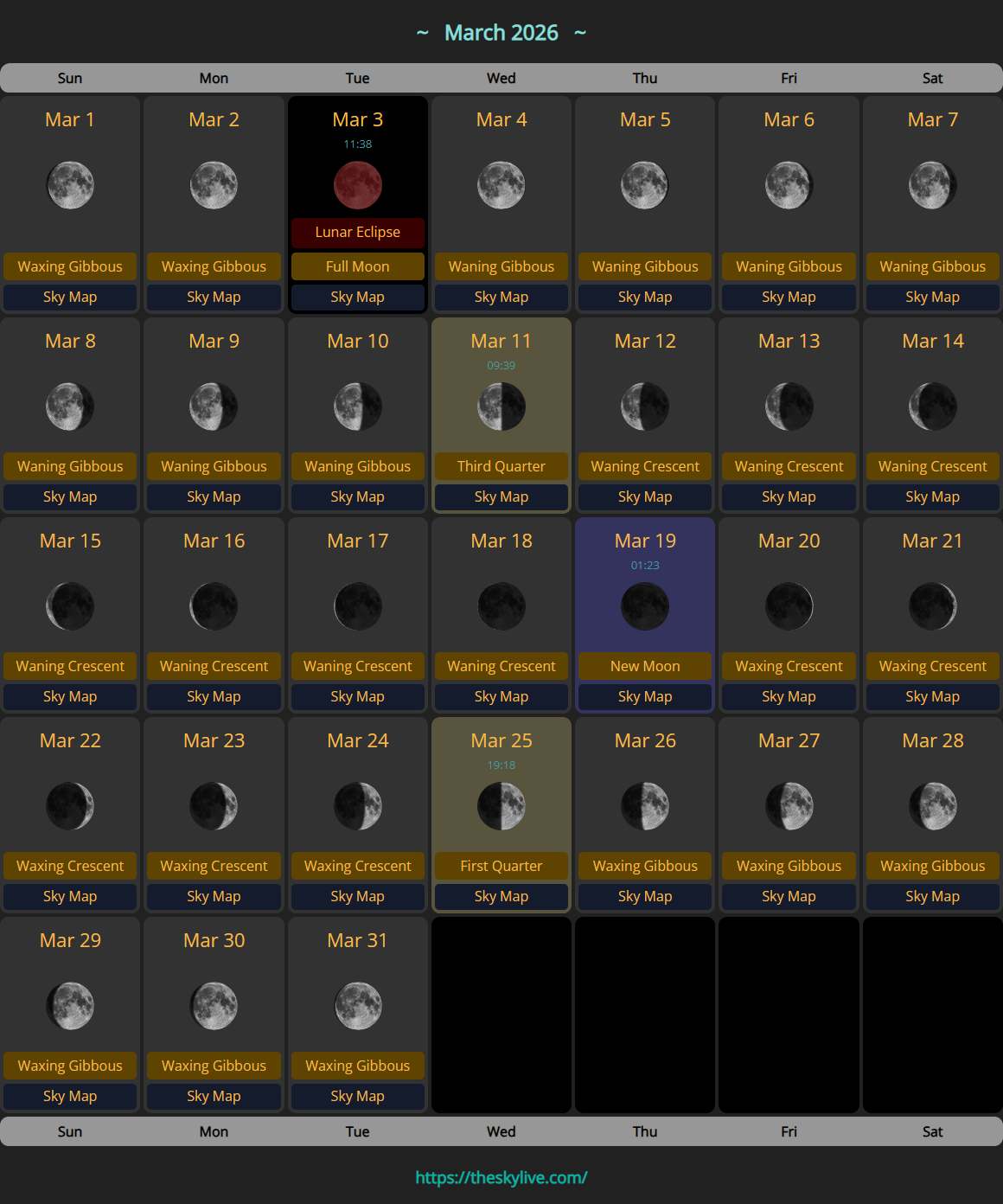
| Moon Phase | Date (March 2026) | Time (ET) |
|---|---|---|
| Full Moon (Worm Moon / Blood Moon) | March 3 | 6:40 AM |
| Last Quarter Moon | March 11 | 1:18 AM |
| New Moon | March 18 | 2:59 PM |
| First Quarter Moon | March 26 | 3:10 AM |
Each phase offers a different visual treat and, for many, a distinct energy. The New Moon is a great time for deep sky observing due to minimal light pollution, while the First and Last Quarters are fantastic for viewing lunar craters and features along the terminator (the line between light and shadow).
Maximizing Your March 2026 Full Moon Experience
Whether you’re a seasoned stargazer or just a casual observer, the March 2026 Full Moon and Total Lunar Eclipse offer a fantastic opportunity to connect with the cosmos. Here’s how to make the most of it.
Stargazing and Photography Tips
- Pick Your Spot Carefully: Choose a location away from city lights for the best view, especially for the eclipse. A wide-open field or a backyard without too many trees obstructing the view is ideal.
- Time it Right: Use the eclipse timetable provided above to know exactly when to start observing for each phase. The totality is relatively short, so don’t be late!
- Photography:
- For basic moon shots, a smartphone on a tripod can work, but a DSLR or mirrorless camera with a telephoto lens will yield stunning results.
- Use a tripod to prevent camera shake during longer exposures, especially as the Moon dims during totality.
- Experiment with ISO and shutter speed settings. During totality, the Moon is much dimmer, requiring higher ISO and longer exposures than a normal full moon.
- Consider capturing the surrounding stars during totality for a unique composition.
- Stay Warm and Comfortable: Bring a blanket, a warm drink, and a comfortable chair if you plan to observe for an extended period.
Connecting with Lunar Cycles
Beyond the scientific observation, many find personal significance in the full moon:
- Reflection and Release: The full moon is often seen as a time for releasing what no longer serves you, completing projects, or reflecting on achievements.
- Setting Intentions: While the New Moon is traditionally associated with new beginnings, the full moon can be a powerful time to manifest intentions or bring plans to fruition.
- Journaling: Take some time to journal under the glow of the Worm Moon. What thoughts, feelings, or insights does this luminous celestial body inspire in you?
- Community: Consider gathering with friends or family to watch the eclipse. Sharing such a profound cosmic event can create lasting memories.
Looking Ahead: The Full Moon Calendar for the Rest of 2026
The March 2026 Full Moon is just one of many celestial gifts throughout the year. 2026 is an exciting year for lunar enthusiasts, featuring not just one, but two total lunar eclipses! The second one will occur in August. Here’s a quick look at the remaining full moons for the year:
| Month | Date (2026) | Traditional Name | Notes |
|---|---|---|---|
| January | January 3 | Wolf Moon | |
| February | February 1 | Snow Moon | |
| March | March 3 | Worm Moon | Total Lunar Eclipse! |
| April | April 2 | Pink Moon | |
| May | May 1 | Flower Moon | |
| May | May 31 | Blue Moon | Seasonal Blue Moon (third of four in a season) |
| July | July 30 | Buck Moon | |
| August | August 29 | Sturgeon Moon | Total Lunar Eclipse! |
| September | September 28 | Harvest Moon | |
| October | October 28 | Hunter’s Moon | |
| November | November 27 | Beaver Moon | |
| December | December 26 | Cold Moon |
What a year for lunar observations! Be sure to keep an eye on the sky for these dazzling events.
The Full Moon in March 2026 promises to be an unforgettable event, thanks to the stunning total lunar eclipse. Whether you’re an avid astronomer or just someone who appreciates the beauty of the night sky, make sure you’re ready to witness the captivating transformation of the Worm Moon into a ‘Blood Moon.’ It’s a powerful reminder of the intricate and dynamic universe we live in, right above our heads. Happy stargazing!
Frequently Asked Questions
When is the Full Moon in March 2026?
The Full Moon in March 2026, known as the Worm Moon, will reach its peak illumination on Tuesday, March 3, 2026, at 11:40 AM Universal Time (UT). This translates to 6:40 AM Eastern Time (ET) in the USA.
Will there be a lunar eclipse in March 2026?
Yes! The March 2026 Full Moon will coincide with a Total Lunar Eclipse, often referred to as a ‘Blood Moon’. The entire continental USA will have the opportunity to view at least part of this spectacular event in the early morning hours of March 3.
What time is the Total Lunar Eclipse on March 3, 2026, in the USA?
For those in the Eastern Time (ET) zone, the Total Eclipse begins at 4:00 AM ET and ends at 5:21 AM ET on March 3, 2026. Viewers in other time zones should adjust accordingly (e.g., Pacific Time will be 3 hours earlier than ET).
Why is it called the ‘Worm Moon’?
The name ‘Worm Moon’ is traditionally associated with Native American and European folklore. It refers to the time in early spring when the ground thaws, and earthworms begin to emerge, signaling the return of birds and the start of the planting season.
Is it safe to look at a Total Lunar Eclipse?
Absolutely! Unlike solar eclipses, it is completely safe to view a Total Lunar Eclipse with the naked eye. No special eye protection is needed. Binoculars or a small telescope can enhance the view of the Moon’s reddish hues.
What is a ‘Blood Moon’?
A ‘Blood Moon’ is a popular term for a Total Lunar Eclipse. During this event, the Moon passes through Earth’s darkest shadow (umbra) and takes on a reddish-orange appearance. This color comes from sunlight scattering through Earth’s atmosphere, with red light being refracted onto the lunar surface.
Are there other lunar eclipses in 2026?
Yes, 2026 is a great year for lunar eclipses! In addition to the Total Lunar Eclipse in March, there will be another Total Lunar Eclipse later in the year, specifically on August 29, 2026, which will also be widely visible.
