Full Moon in March 2026: Your Essential Guide to the Worm Moon & Total Lunar Eclipse
Ever look up at the night sky and feel a pull towards that luminous orb? Whether you’re an avid stargazer, an astrology enthusiast, or simply curious about the celestial ballet above, the March 2026 Full Moon is shaping up to be a truly spectacular event. It’s not just a full moon; it’s the Worm Moon, and it comes bundled with a rare celestial treat: a Total Lunar Eclipse!
No need to scour multiple sources for dates and times. You’ve landed on the definitive guide. Let’s dive straight into when and how you can experience this captivating celestial display.
The March 2026 Full Moon: Date, Time, and Name Revealed
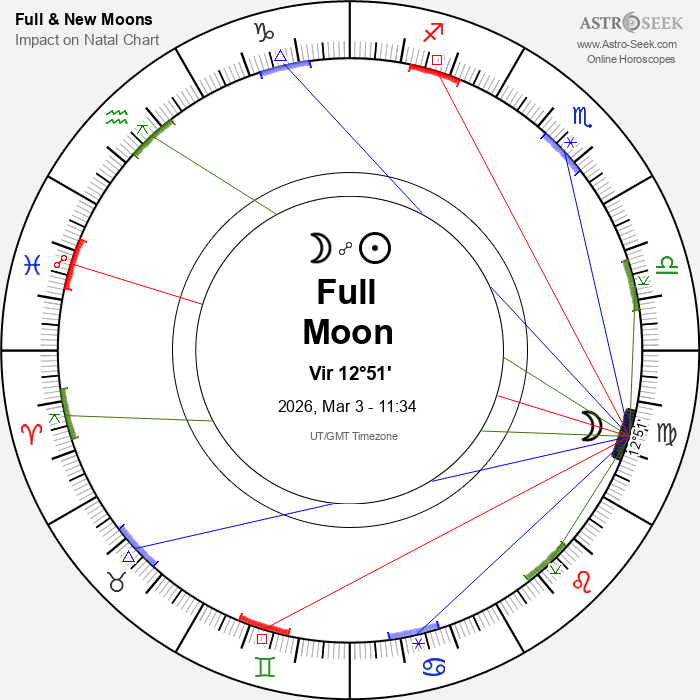
Mark your calendars, because the Full Moon in March 2026 reaches its peak illumination on Tuesday, March 3, 2026. For those of us in the Eastern Time (ET) zone of the USA, this magical moment occurs at precisely 6:38 AM ET. While it peaks in the morning, the Moon will appear gloriously full in the night sky both leading up to and following this exact moment.
This particular full moon is traditionally known as the Worm Moon, a name steeped in seasonal significance that we’ll explore shortly. But what makes this March full moon truly exceptional is its alignment with a Total Lunar Eclipse, offering a breathtaking opportunity to witness the Moon turn a stunning shade of red.
Quick Glance: March 2026 Full Moon Details
| Event | Date | Time (ET) | Time (UTC) | Traditional Name | Special Event |
|---|---|---|---|---|---|
| Full Moon Peak Illumination | Tuesday, March 3, 2026 | 6:38 AM ET | 11:38 UTC | Worm Moon | Total Lunar Eclipse |
Understanding the Time Zones
Celestial events, by their nature, occur at a precise universal time. For clarity, we always provide the Universal Coordinated Time (UTC), and then convert it to major U.S. time zones so you know exactly when to look up from your specific location.
- UTC: 11:38 AM UTC
- Eastern Time (ET): 6:38 AM ET (Tuesday, March 3)
- Central Time (CT): 5:38 AM CT (Tuesday, March 3)
- Mountain Time (MT): 4:38 AM MT (Tuesday, March 3)
- Pacific Time (PT): 3:38 AM PT (Tuesday, March 3)
Keep in mind that while the peak illumination is given for a specific second, the Moon will appear full to the naked eye for roughly three days surrounding this time. So, if you miss the exact peak, you’ll still get a magnificent view!
Beyond the Full Moon: All Phases of March 2026
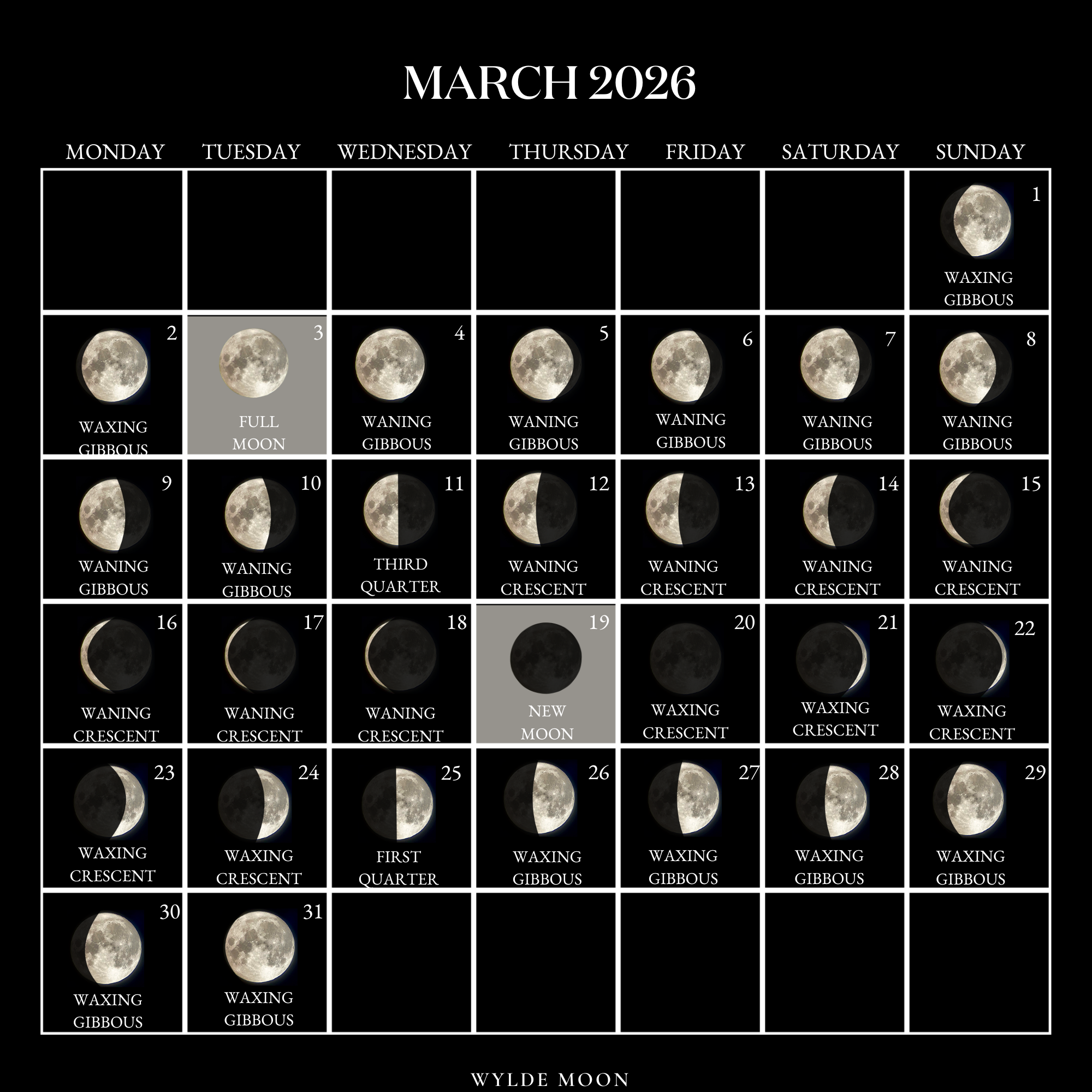
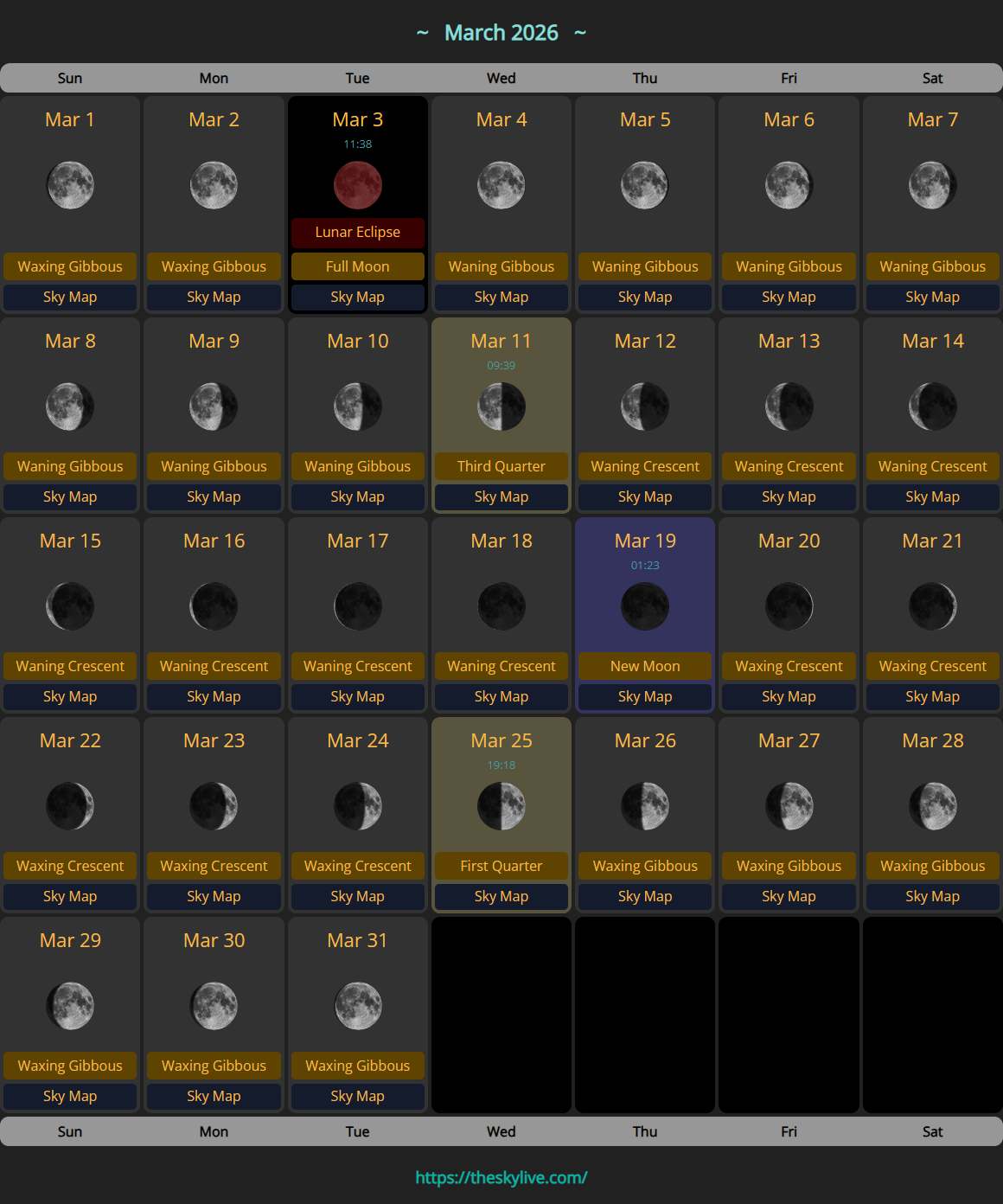
The full moon is just one stop on the Moon’s monthly journey around Earth. Understanding the entire lunar cycle for March 2026 can help you appreciate the subtle shifts in illumination and plan any moon-gazing activities. Here’s a quick overview of the main phases:
| Moon Phase | Date (2026) | Time (ET) | Time (UTC) |
|---|---|---|---|
| Last Quarter | February 24 | 7:05 AM | 12:05 UTC |
| Full Moon (Worm Moon) | March 3 | 6:38 AM | 11:38 UTC |
| New Moon | March 11 | 3:24 PM | 20:24 UTC |
| First Quarter | March 18 | 11:21 PM | 04:21 UTC (March 19) |
Visualizing the Lunar Cycle
The Moon’s phases are determined by the changing angles at which we view the Sun’s illumination on its surface as it orbits Earth. Each phase has its own unique charm and impact:
- New Moon: The Moon is not visible as it’s between the Earth and the Sun. A time for new beginnings and setting intentions.
- First Quarter: Half of the Moon is illuminated, growing towards fullness. A period of action and growth.
- Full Moon: The entire face of the Moon is illuminated, directly opposite the Sun. A peak of energy, revelation, and culmination.
- Last Quarter: The other half of the Moon is illuminated, waning towards darkness. A time for release, reflection, and winding down.
Throughout March 2026, you’ll be able to observe these transformations, but the Full Worm Moon on March 3rd will undoubtedly be the highlight.
The Worm Moon: Unpacking Its Traditional Name
Why do we call the March full moon the “Worm Moon”? These traditional names for full moons, often attributed to Native American, Colonial American, and European folklore, are deeply connected to the changing seasons and natural events occurring at that time of year.
Origins and Seasonal Significance
The Worm Moon name originates from early spring observations. As the ground begins to thaw after winter’s freeze, earthworms re-emerge, inviting birds to feed and signaling the return of fertile soil. For many cultures, this was a critical indicator that spring was truly underway and that planting season was approaching. It’s a symbol of renewal, awakening, and the stirring of life beneath the surface of the Earth.
Imagine our ancestors, keenly observing nature’s calendar. The sight of worms, birds, and the longer days under a bright full moon would have been a comforting sign of the cold fading away, replaced by the promise of warmth and abundance.
Alternative Names for March’s Full Moon
While Worm Moon is the most common, March’s full moon has been known by several other names across different cultures, all reflecting the seasonal changes:

- Crow Moon: Named for the cawing of crows signaling the end of winter.
- Sap Moon: Reflecting the time when maple tree sap begins to flow.
- Crust Moon: From the crust of snow that forms over thawing ground, making it harder to walk.
- Lenten Moon: In some Christian traditions, this refers to the full moon that falls during the period of Lent.
Each name offers a glimpse into how different communities interacted with the natural world and marked the passage of time. The common thread is the theme of rebirth and the shedding of winter’s dormant energy.
A Celestial Spectacle: The March 2026 Total Lunar Eclipse
As if a full moon isn’t magnificent enough, the March 2026 Worm Moon will coincide with a Total Lunar Eclipse! This is a truly special event where the Earth positions itself directly between the Sun and the Moon, casting a shadow that temporarily obscures the Moon’s bright face.
During a total lunar eclipse, the Moon doesn’t completely disappear. Instead, it often takes on a stunning reddish or coppery hue, earning it the evocative nickname “Blood Moon.” This happens because some sunlight, refracted and scattered by Earth’s atmosphere, still reaches the Moon. Imagine all the sunsets and sunrises happening around the globe projecting their red light onto the lunar surface – that’s essentially what you’re seeing!
Visibility in the USA: Can You See It?
The visibility of the March 2026 Total Lunar Eclipse for observers in the USA is a critical question. Based on current projections, the eclipse will be visible across North and South America, as well as parts of Europe and Africa. This means a significant portion of the USA will have a prime viewing opportunity, especially in the western and central regions where the eclipse will occur higher in the night sky.
For those on the East Coast, the eclipse will be underway as the Moon sets, meaning you’ll catch the beginning and perhaps the totality if you have a clear, western horizon. The further west you are, the better the view will be, with the Midwest, Mountain States, and West Coast experiencing the full show high above.
Key Eclipse Times (all times in ET):

- Partial Umbral Eclipse Begins: March 3, 4:44 AM ET
- Total Eclipse Begins: March 3, 5:49 AM ET
- Maximum Eclipse (Blood Moon): March 3, 6:38 AM ET (coincides with full moon peak)
- Total Eclipse Ends: March 3, 7:26 AM ET
- Partial Umbral Eclipse Ends: March 3, 8:32 AM ET
Remember to check local sunrise times for your exact location, as the rising sun can quickly wash out the visibility of a setting eclipsed moon. If you’re on the East Coast, an early start and a good western vantage point will be key!
How to Observe the Lunar Eclipse Safely
Unlike solar eclipses, lunar eclipses are completely safe to view with the naked eye! You don’t need any special equipment or protective eyewear. In fact, a lunar eclipse is one of the easiest astronomical events to observe.
Here’s how to make the most of it:
- Find a Dark Spot: While not as crucial as for stargazing, a location away from city lights will enhance the reddish hues of the Moon.
- Look West (for East Coast viewers) or Up (for Western viewers): Position yourself with an unobstructed view of the sky in the direction the Moon will be setting (East Coast) or simply look up (further west).
- Bring Binoculars or a Telescope (Optional): These will offer a magnified view, allowing you to appreciate the subtle colors and textures on the eclipsed lunar surface, but they are by no means necessary.
- Dress Warmly: Early March mornings can still be quite chilly, so bundle up if you plan to be outside for a while.
- Set Your Alarm: Don’t rely on waking up naturally! The eclipse progression happens over several hours, so set an alarm for the start of totality if you want to catch the deepest red.
This is a fantastic opportunity to share a celestial event with family and friends, offering a moment of quiet awe and connection to the universe.
The Astrological & Energetic Significance of the March 2026 Full Moon in Pisces
Beyond its astronomical marvel, the March 2026 Full Moon carries a unique energetic signature, as it occurs in the intuitive and mystical water sign of Pisces. Full moons are always powerful culminations, bringing matters to light, intensifying emotions, and often signaling a time for release or completion.
With the Full Moon in Pisces, ruled by Neptune, we can expect an emphasis on themes of:
- Spirituality and Intuition: A heightened sense of connection to the divine, dreams, and our inner wisdom.
- Compassion and Empathy: Our sensitivity to others’ feelings and our desire to help may be amplified.
- Creativity and Imagination: Pisces is an artistic sign, so this full moon could inspire breakthroughs in creative projects.
- Healing and Release: It’s a potent time to let go of old patterns, emotional baggage, or anything that no longer serves your highest good.
- Escapism vs. Reality: The challenge can be to stay grounded amidst the surge of dreamy, sometimes overwhelming, emotions.
The added layer of a lunar eclipse only magnifies these energies, suggesting that whatever comes to a head or is released during this period will have profound and lasting implications. Eclipses often act as cosmic wildcards, accelerating changes and revealing hidden truths.
Reflecting on Your Path
Consider using the energy of this Full Worm Moon and Lunar Eclipse to engage in some introspection:
- What emotional patterns or illusions are you ready to release?
- How can you better integrate your spiritual insights into your daily life?
- Where in your life do you need more compassion, both for yourself and others?
- Are there creative endeavors calling to you that deserve your attention?
This isn’t just a day to observe the sky; it’s an invitation to observe your inner landscape, too.
Beyond March: All Full Moon Dates for 2026
The March Worm Moon is just one of many opportunities to connect with our lunar companion throughout 2026. For your planning convenience, here is a complete calendar of all full moon dates for the year, including their traditional names and notable events:
| Date (2026) | Traditional Name | Time (ET) | Special Event |
|---|---|---|---|
| January 3 | Wolf Moon | 5:03 AM | Supermoon |
| February 1 | Snow Moon | 5:09 PM | |
| March 3 | Worm Moon | 6:38 AM | Total Lunar Eclipse |
| April 1 | Pink Moon | 10:12 PM | |
| May 1 | Flower Moon | 6:36 PM | |
| May 31 | Strawberry Moon | 7:02 AM | |
| June 30 | Buck Moon | 6:08 PM | |
| July 30 | Sturgeon Moon | 1:03 PM | |
| August 29 | Corn Moon | 6:02 AM | |
| September 27 | Harvest Moon | 9:18 PM | |
| October 27 | Hunter’s Moon | 12:50 PM | |
| November 26 | Beaver Moon | 4:47 AM | |
| December 25 | Cold Moon | 7:33 PM |
Note that in some years, there can be 13 full moons, which means one of the months will host two full moons (a ‘Blue Moon’). 2026 has the standard 12 full moons, one for each month, making the March event all the more unique with its accompanying eclipse.
Fun Facts About Full Moons and Lunar Phenomena
Our Moon has fascinated humanity for millennia, inspiring myths, scientific inquiry, and a deep sense of wonder. Here are a few fascinating tidbits:
- Tides: The Moon’s gravitational pull is the primary cause of Earth’s ocean tides. Full and New Moons create particularly strong “spring tides” due to the alignment of the Sun, Earth, and Moon.
- Harvesting and Planting: For centuries, farmers and gardeners have observed lunar cycles, believing that specific moon phases influence plant growth and harvest yields.
- Lunar Effect: While often dismissed as folklore, some studies suggest subtle correlations between full moons and various phenomena, including sleep patterns, hospital admissions, and even crime rates. The scientific community largely attributes these to psychological biases, but the mystery persists!
- Not Always White: The Moon isn’t always a sterile white. Besides the reddish hue of a lunar eclipse, atmospheric conditions can make the full moon appear yellow, orange, or even deep red when it’s low on the horizon, due to light scattering.
- Moon Illusion: Have you ever noticed that the Moon appears much larger when it’s near the horizon than when it’s high in the sky? This is a well-known optical illusion, with various theories attempting to explain it.
The March 2026 Full Worm Moon, with its accompanying total lunar eclipse, is more than just a date on a calendar; it’s an opportunity to pause, look up, and connect with the ancient rhythms of our universe. Whether you’re planning to observe the eclipse, reflect on its astrological meaning, or simply enjoy the sight of a bright full moon, prepare for a truly memorable celestial event.
n
Frequently Asked Questions
What is the exact date and time of the March 2026 Full Moon?
The Full Moon in March 2026 will reach its peak illumination on Tuesday, March 3, 2026, at 6:38 AM Eastern Time (ET) or 11:38 UTC. It will appear full to the naked eye for approximately three days around this date.
What is the traditional name for the March 2026 Full Moon?
The March 2026 Full Moon is traditionally known as the ‘Worm Moon.’ This name signifies the thawing of the ground in early spring, allowing earthworms to emerge and birds to return, marking the start of a new season.
Will there be a lunar eclipse during the March 2026 Full Moon?
Yes, the March 2026 Full Worm Moon will coincide with a Total Lunar Eclipse. This is a spectacular event where the Moon passes through Earth’s shadow, often taking on a reddish hue, also known as a ‘Blood Moon.’
What is the visibility of the March 2026 Total Lunar Eclipse in the USA?
The March 2026 Total Lunar Eclipse will be visible across North and South America. Observers in the western and central USA will have excellent views high in the sky. East Coast viewers will see the eclipse in progress as the Moon sets, requiring an early start and a clear western horizon.
What does the March 2026 Full Moon in Pisces signify astrologically?
Occurring in the intuitive sign of Pisces, this Full Moon, amplified by the lunar eclipse, emphasizes themes of spirituality, compassion, creativity, and emotional release. It’s a powerful time for introspection, healing, and letting go of old patterns.
How can I best observe the Full Moon or lunar eclipse in March 2026?
Lunar eclipses are safe to view with the naked eye. For the best experience, find a dark location away from city lights and position yourself with an unobstructed view. Binoculars or a telescope can enhance the view but are not necessary. Dress warmly for early morning viewing.
What are the other moon phases in March 2026?
Besides the Full Worm Moon on March 3, 2026, the main moon phases for March include the New Moon on March 11 (3:24 PM ET) and the First Quarter Moon on March 18 (11:21 PM ET). The Last Quarter Moon occurs on February 24 (7:05 AM ET).
