Your Essential Guide to March 2026: India’s Holidays and Vibrant Festivals
Planning your schedule, travel, or business dealings with India in March 2026? You’ve landed in the right place. Understanding India’s diverse calendar is key to navigating its dynamic culture, especially when vibrant festivals and significant observances shape daily life. Unlike a straightforward Western calendar, India’s dates are a rich tapestry woven with national holidays, regional celebrations, and deeply spiritual festivals.

This isn’t just a list of dates; it’s your go-to resource for understanding the cultural heartbeat of India in March 2026. We’ll cut through the noise, skip the generic ‘fun facts’ about global observances, and give you precisely what you need: a clear, insightful breakdown of India’s specific holidays and festivals, their significance, and what they mean for you, whether you’re planning a trip from the USA or simply engaging with Indian colleagues or friends.
March 2026 Indian Calendar: At a Glance
March in India is often a transitional month, bidding farewell to winter and welcoming the onset of spring. For 2026, it’s particularly significant as it hosts one of India’s most iconic and colorful festivals: Holi, the Festival of Colors. Beyond this exuberant celebration, you’ll find a series of other important observances rooted in various regional traditions and religious calendars.
Key Takeaways for March 2026 in India
- Holi Dominates the First Week: The Purnimant calendar places Holika Dahan and Holi very early in March, making it the month’s primary festive event.
- Hindu Calendar Influence: Many key observances in March 2026 stem from the Hindu lunisolar calendar, marking important tithis (lunar days) and mythological events.
- Regional Variations: While Holi is nationwide, other festivals like Rang Panchami and Sheetala Ashtami often have stronger regional significance and observances.
- Impact on Daily Life: Expect closures for government offices, banks, and some businesses during major festivals, particularly Holi. Travel and public services might be affected.
Dive into March 2026: India’s National Holidays
When we talk about ‘national holidays’ in India, we typically refer to three major ones: Republic Day (January 26), Independence Day (August 15), and Mahatma Gandhi’s Birthday (October 2). These are observed uniformly across the entire country, meaning government offices, banks, and most businesses are closed. However, for March 2026, there are no specific national holidays that apply universally across India in the same vein as these three.
Instead, March 2026 features several significant religious festivals that, while not ‘national’ in the strictest sense, are declared public holidays in various states and regions. This regional declaration means that the impact on daily life, business, and travel will depend on the specific festival and your location within India. The most prominent of these in March 2026 is undoubtedly Holi.

March 2026: A Spectrum of Indian Festivals
March 2026 is vibrant with cultural and religious celebrations. Here’s a closer look at the key festivals that will light up the month, offering a window into India’s rich traditions.
Major Hindu Festivals in March 2026
The majority of significant observances in March 2026 are Hindu festivals, each with its own unique rituals, stories, and cultural expressions.
- March 3, 2026 (Tuesday): Holika Dahan
Holika Dahan is the precursor to Holi, celebrated on the eve of the main festival. It symbolizes the triumph of good over evil. Bonfires are lit in public spaces and homes, representing the burning of the demoness Holika, who tried to burn Prahlada, a devotee of Lord Vishnu. People gather around these bonfires, performing rituals, offering raw mangoes, coconut, and corn, and singing religious songs. It’s a community event that purifies and prepares for the joyous colors of Holi the next day. - March 4, 2026 (Wednesday): Holi
Without a doubt, Holi is one of India’s most exuberant and widely celebrated festivals. Known as the ‘Festival of Colors,’ it marks the arrival of spring, the victory of good over evil, and the joy of love. People gather to throw vibrant colored powders (gulal) and water at each other, singing, dancing, and feasting on special delicacies like Gujiya and Thandai. While it’s a day of uninhibited fun and revelry, it also carries the message of unity, forgiveness, and new beginnings. Many businesses and educational institutions will be closed on this day, especially in North India. - March 8, 2026 (Sunday): Rang Panchami
Five days after Holi, Rang Panchami is celebrated, primarily in certain parts of India, notably Maharashtra and Madhya Pradesh. It is believed that on this day, the active ‘raja-tama’ particles (spiritual impurities) in the atmosphere are reduced, and the positive vibrations spread by colors invite deities. While less boisterous than Holi, it still involves playing with colors, albeit in a more subdued manner, and is seen as completing the festive spirit of Holi. For those in the USA interacting with these regions, expect continued festive mood and some reduced activity. - March 10, 2026 (Tuesday): Sheetala Saptami
Observed on the seventh day after Holi (Krishna Paksha Saptami), Sheetala Saptami is dedicated to Goddess Sheetala, believed to protect against diseases, especially smallpox. Devotees offer prayers and partake in specific rituals, often involving eating stale food (cooked the previous day) as an offering. This festival is more prevalent in parts of Northern India and is a day of quiet devotion and tradition rather than widespread public celebration. - March 11, 2026 (Wednesday): Sheetala Ashtami
Following Sheetala Saptami, Sheetala Ashtami is observed on the eighth day. The rituals are similar to Saptami, with devotees offering prayers to Goddess Sheetala and adhering to customs like not lighting fires for cooking on this day. It is a day of reverence and health-related prayers, particularly significant in Rajasthan, Gujarat, and Uttar Pradesh. These are not typically public holidays that close businesses nationwide, but local observances will be strong.
Other Significant Regional/Religious Observances in March 2026
While the Hindu festivals dominate March 2026, India’s multicultural fabric means there are always other regional and religious observances. However, based on current calendrical data for March 2026, no other major nationwide non-Hindu festivals are typically declared as public holidays. Smaller, localized observances for Sikh, Jain, Christian, or Islamic communities might occur, but their impact on general public life would be localized and less widespread than Holi.
Your Comprehensive March 2026 India Calendar (With All Key Dates)
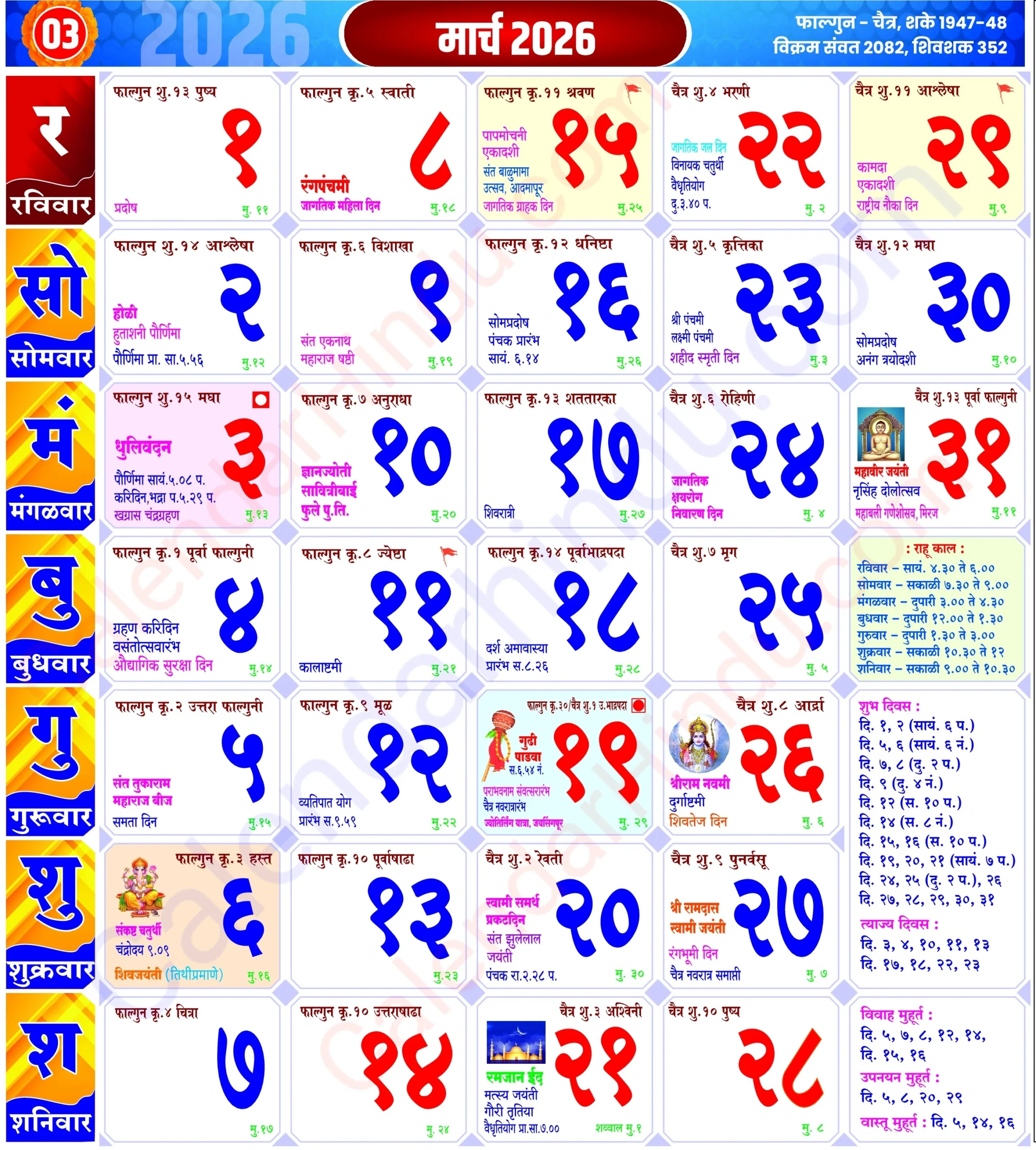
Here’s a practical, day-by-day overview of March 2026, highlighting all the important dates, festivals, and observances you need to know.
| Date | Day | Notable Event/Holiday/Festival | Type |
|---|---|---|---|
| March 1 | Sunday | Weekend | General |
| March 2 | Monday | Working Day | General |
| March 3 | Tuesday | Holika Dahan | Religious Festival |
| March 4 | Wednesday | Holi | Religious Festival (Public Holiday in many states) |
| March 5 | Thursday | Working Day (Post-Holi observation in some areas) | General |
| March 6 | Friday | Working Day | General |
| March 7 | Saturday | Weekend | General |
| March 8 | Sunday | Rang Panchami, Weekend | Religious Festival / General |
| March 9 | Monday | Working Day | General |
| March 10 | Tuesday | Sheetala Saptami | Religious Observance (Regional) |
| March 11 | Wednesday | Sheetala Ashtami | Religious Observance (Regional) |
| March 12 | Thursday | Working Day | General |
| March 13 | Friday | Working Day | General |
| March 14 | Saturday | Weekend | General |
| March 15 | Sunday | Weekend | General |
| March 16 | Monday | Working Day | General |
| March 17 | Tuesday | Working Day | General |
| March 18 | Wednesday | Working Day | General |
| March 19 | Thursday | Working Day | General |
| March 20 | Friday | Working Day | General |
| March 21 | Saturday | Weekend | General |
| March 22 | Sunday | Weekend | General |
| March 23 | Monday | Working Day | General |
| March 24 | Tuesday | Working Day | General |
| March 25 | Wednesday | Working Day | General |
| March 26 | Thursday | Working Day | General |
| March 27 | Friday | Working Day | General |
| March 28 | Saturday | Weekend | General |
| March 29 | Sunday | Weekend | General |
| March 30 | Monday | Working Day | General |
| March 31 | Tuesday | Working Day | General |
Planning Your India Interactions from the USA in March 2026
For those in the United States looking to engage with India during March 2026, understanding the festival calendar is not just interesting—it’s practical. These insights can significantly impact your travel plans, business operations, and overall experience.
Travel Considerations
If you’re planning to visit India in March 2026, particularly around the first week, be prepared for the vibrant chaos and joy of Holi. This can be an incredible cultural experience, but it comes with practical considerations:
- Transportation: Around Holi (March 3-4), inter-city travel (trains, buses) can be incredibly crowded as people travel to their hometowns. Book tickets well in advance. Local transport might also be limited on Holi day itself.
- Accommodation: Hotels in popular tourist destinations might be booked, and prices could be higher during peak festival periods. Research local observances; some areas might have specific events or closures.
- Local Closures: Many shops, restaurants, and attractions, especially in North India, will be closed on Holi. Expect reduced services on these days. After Holi, some businesses might open later or have limited hours for a day or two.
- Embrace the Spirit: If you’re open to participating, Holi is an unforgettable experience! Wear old clothes, protect your belongings, and be ready to be covered in color. If you prefer to observe, choose accommodations that offer a quieter environment or local celebrations within their premises.
Business Implications
For businesses or individuals in the USA with operations, partners, or clients in India, understanding the March 2026 calendar is crucial for maintaining seamless communication and productivity.

- Public Holidays: Holi (March 4) will be a public holiday in many Indian states. This means non-working days for banks, government offices, and many private sector companies. Expect slower response times or complete closures on these days.
- Regional Variations: While Holi is widespread, remember that other observances like Rang Panchami, Sheetala Saptami, and Ashtami are primarily regional. Check with your Indian counterparts for specific holiday schedules in their respective states.
- Cultural Sensitivity: Acknowledging these festivals, even with a simple greeting, can strengthen professional relationships. Be mindful of scheduling important calls or deadlines around festival dates.
- Planning Ahead: Proactively communicate with your Indian teams or partners about the March schedule. Factor in potential delays or reduced availability around the first week of the month.
Experiencing Indian Culture from Afar
Even if you’re not in India, you can still embrace the spirit of March’s festivals:
- Holi Celebrations in the USA: Many Indian diaspora communities in the United States host their own Holi events. Look for local temples, cultural centers, or university groups organizing ‘Holi Milan’ (Holi meet-ups) where you can experience the colors and joy.
- Culinary Exploration: Try making or finding traditional Holi sweets like Gujiya or sipping on a refreshing Thandai.
- Learn and Share: Use these festivals as an opportunity to learn more about Indian mythology, customs, and regional diversity. Share your knowledge with friends and family to foster cross-cultural understanding.
Decoding India’s Diverse Calendars: Why Dates Can Vary
You might occasionally notice slight date variations for Indian festivals across different sources or regions. This isn’t an error; it’s a reflection of India’s rich calendrical diversity.
While the Gregorian calendar (the one we commonly use in the USA and globally) sets fixed dates for months and years, many Indian festivals are determined by lunisolar calendars, primarily the Hindu calendar (Panchang). This calendar tracks both lunar cycles (tithis or lunar days) and solar cycles, leading to festivals falling on different Gregorian dates each year.
Furthermore, regional traditions within India might follow slightly different astronomical calculations or have specific local customs that shift dates by a day or two. For instance, some regions might follow a ‘Purnimant’ calendar (ending the month on a full moon), while others use an ‘Amavasyant’ calendar (ending on a new moon). This article primarily follows widely accepted dates based on common Panchangs for the specified year.
The key takeaway? Always refer to a reliable source that specifies the region if you need absolute precision, especially for planning purposes. For March 2026, the dates provided for Holi and other major festivals are broadly accepted.
March 2026 in India is poised to be a month of extraordinary colors, deep spiritual reflection, and vibrant community gatherings. From the joyous splashes of Holi to the quiet devotions of Sheetala Ashtami, it offers a fascinating glimpse into India’s soul. By understanding these observances, you’re not just reading a calendar; you’re gaining a deeper appreciation for one of the world’s most ancient and diverse cultures. So, go ahead and plan your month with confidence, enriched by the knowledge of India’s unique festive spirit!
Frequently Asked Questions
What are the major Indian holidays in March 2026?
The most significant Indian holidays and festivals in March 2026 are Holika Dahan (March 3), Holi (March 4), Rang Panchami (March 8), Sheetala Saptami (March 10), and Sheetala Ashtami (March 11). Holi is the most widely celebrated and impactful event of the month.
Will government offices and banks be closed in India during March 2026?
Yes, many government offices, banks, and businesses will be closed on March 4, 2026, for Holi, particularly in states where it is a declared public holiday. Other regional festivals like Sheetala Saptami/Ashtami might cause localized closures, but not typically nationwide shutdowns.
What is Holi and how is it celebrated?
Holi, known as the ‘Festival of Colors,’ celebrates the arrival of spring and the triumph of good over evil. It’s celebrated by throwing vibrant colored powders and water, singing, dancing, and enjoying special sweets and drinks. It’s a joyous, communal event for all ages.
How do Indian festival dates vary from the Gregorian calendar?
Many Indian festivals are determined by lunisolar calendars, primarily the Hindu calendar (Panchang), which tracks both lunar and solar cycles. This means their dates shift annually relative to the fixed Gregorian calendar. Regional interpretations can also cause slight variations.
What should a US traveler know if visiting India during Holi in March 2026?
If visiting during Holi (March 3-4), expect crowded transportation, potential closures of shops/attractions, and higher accommodation prices. It’s an incredible cultural experience, but be prepared for lively celebrations involving colors. Book travel and lodging well in advance, and protect your belongings if participating.
Are there any nationwide public holidays in India during March 2026?
In the strictest sense, no ‘national’ public holidays (like Republic Day or Independence Day) fall in March 2026. However, major festivals like Holi are declared public holidays in many Indian states, effectively creating regional non-working days.

How can I celebrate Indian festivals from the USA?
You can experience Indian culture from the USA by finding local Indian diaspora communities hosting Holi events, trying traditional Indian sweets like Gujiya or drinks like Thandai, and learning more about the festivals’ significance and stories.
