March 2026 Full Moon & Total Lunar Eclipse: Your Ultimate Guide to the Worm Moon
Ever gazed up at the full moon, feeling its silent power? What if that celestial glow was amplified by a rare cosmic dance? If you’re looking forward to the March 2026 Full Moon, you’re in for a spectacular treat. This isn’t just any full moon; it’s the traditionally named Worm Moon, and it arrives with an awe-inspiring bonus: a Total Lunar Eclipse!
Mark your calendars, because on Tuesday, March 3, 2026, the night sky will put on a show you won’t want to miss. For skywatchers across the Americas, this will be a prime opportunity to witness Earth’s shadow paint the Moon in hues of red and orange, transforming it into a magnificent “Blood Moon.” Let’s dive into everything you need to know to experience this celestial event to the fullest.
The March 2026 Full Moon: The Worm Moon Arrives with an Eclipse!
The March Full Moon holds a special place in the annual lunar cycle, heralding the imminent arrival of spring. In 2026, its brilliance will be momentary overshadowed – in the best possible way – by a total lunar eclipse, making it an extraordinary event for observers in the United States.
Key Details: Date, Time, and Name
The Full Moon officially reaches its peak illumination for North America in the early morning hours of Tuesday, March 3, 2026. This particular full moon is widely known as the Worm Moon, a name steeped in tradition and connected to the natural world around us.
| Date | Peak Illumination Time (EST) | Peak Illumination Time (PST) | Traditional Name | Associated Event |
|---|---|---|---|---|
| Tuesday, March 3, 2026 | 6:38 AM EST | 3:38 AM PST | Worm Moon | Total Lunar Eclipse |
While the full illumination peaks just after dawn on the East Coast, the preceding night will feature the main spectacle of the eclipse. So, you’ll want to be looking up late on the night of March 2nd into the early morning of March 3rd!
A Celestial Spectacle: The Total Lunar Eclipse of March 3, 2026
This is where the March 2026 Full Moon truly distinguishes itself. Not only will the moon be full, but it will also pass entirely through Earth’s darkest shadow, creating a breathtaking Total Lunar Eclipse. This event is a magnificent reminder of our planet’s place in the solar system and an accessible astronomical wonder for everyone.
What is a Total Lunar Eclipse?
A lunar eclipse occurs when the Earth positions itself directly between the Sun and the Moon, casting a shadow on our natural satellite. There are three main types of lunar eclipses: penumbral, partial, and total.
- Penumbral Lunar Eclipse: The Moon passes through Earth’s faint outer shadow (penumbra). This is often subtle and difficult to notice.
- Partial Lunar Eclipse: Only a portion of the Moon passes through Earth’s dark inner shadow (umbra).
- Total Lunar Eclipse: The entire Moon passes through the Earth’s umbra. This is the most dramatic type, often leading to the famous “Blood Moon” phenomenon.
During a total lunar eclipse, the Moon doesn’t completely disappear. Instead, it takes on a reddish or orange hue. This happens because some sunlight still manages to filter through Earth’s atmosphere, bending around our planet and scattering blue light more effectively than red light. The redder light then illuminates the Moon, creating a captivating celestial glow. The exact shade can vary depending on dust, clouds, and other atmospheric conditions on Earth at the time of the eclipse.
Visibility and Timings for the USA
The Total Lunar Eclipse of March 3, 2026, will be highly favorable for observers across the Americas, the Pacific, and parts of Asia and Australia. For those in the contiguous United States, Canada, and Mexico, you’ll have an excellent view, weather permitting.
Here are the approximate timings for the various phases of the eclipse in common USA time zones. Remember that these are general times, and local conditions can slightly affect visibility.
| Eclipse Phase | EST (Eastern Standard Time) | CST (Central Standard Time) | MST (Mountain Standard Time) | PST (Pacific Standard Time) |
|---|---|---|---|---|
| Penumbral Eclipse Begins | 1:40 AM | 12:40 AM | 11:40 PM (Mar 2) | 10:40 PM (Mar 2) |
| Partial Eclipse Begins | 2:50 AM | 1:50 AM | 12:50 AM | 11:50 PM (Mar 2) |
| Total Eclipse Begins | 4:00 AM | 3:00 AM | 2:00 AM | 1:00 AM |
| Maximum Eclipse | 4:45 AM | 3:45 AM | 2:45 AM | 1:45 AM |
| Total Eclipse Ends | 5:30 AM | 4:30 AM | 3:30 AM | 2:30 AM |
| Partial Eclipse Ends | 6:40 AM | 5:40 AM | 4:40 AM | 3:40 AM |
| Penumbral Eclipse Ends | 7:50 AM | 6:50 AM | 5:50 AM | 4:50 AM |
How to Observe the Eclipse Safely and Enjoyably
Unlike a solar eclipse, a lunar eclipse is perfectly safe to observe with the naked eye. You don’t need any special filters or equipment. Here’s how to make the most of the experience:
- Find a Dark Spot: While the moon is bright, a darker location away from city lights will enhance the view of the subtle reddish hues during totality.
- Binoculars or a Telescope (Optional): These can offer a magnified view, revealing craters and features on the Moon’s surface as it changes color. It’s a fantastic way to appreciate the details!
- Dress Warmly: Since this is an overnight event in early March, remember to bundle up, especially if you plan to observe for an extended period.
- Bring a Chair or Blanket: Make yourself comfortable! Staring upwards for an hour or more can be tiring.
- Enjoy the Moment: Turn off your phone, minimize distractions, and simply immerse yourself in the natural wonder unfolding above.
Understanding the March “Worm Moon” Name
The names we give to the Full Moons throughout the year often reflect ancient traditions and the changing seasons. The Worm Moon is a prime example of this connection between humanity and the celestial calendar.
Origins and Significance
The name “Worm Moon” is widely believed to originate from Native American tribes and early American colonists. It signifies the time of year when the ground begins to thaw after the long, cold winter. As the soil warms, earthworms start to emerge, attracting robins and other birds – a sure sign that spring is on its way. This name beautifully captures the awakening of the land and the reemergence of life.
For indigenous cultures, tracking these seasonal changes was critical for survival, dictating planting, hunting, and migratory patterns. The Full Moon acted as a natural calendar, reminding communities of these vital transitions.

Other Names for the March Full Moon
While “Worm Moon” is the most common name, different cultures and regions had their own ways of describing the March Full Moon, each reflecting their unique environment and observations:
- Crow Moon: Named by some tribes for the cawing of crows signaling the end of winter.
- Sap Moon / Sugar Moon: Referencing the tapping of maple trees for sap, a vital spring activity.
- Lenten Moon: In Christian tradition, this name refers to the Lenten period leading up to Easter.
- Crust Moon: Indicating that the snow crust becomes soft during the day and freezes hard at night.
Each name paints a vivid picture of the shift from winter’s dormancy to spring’s vibrant reawakening.
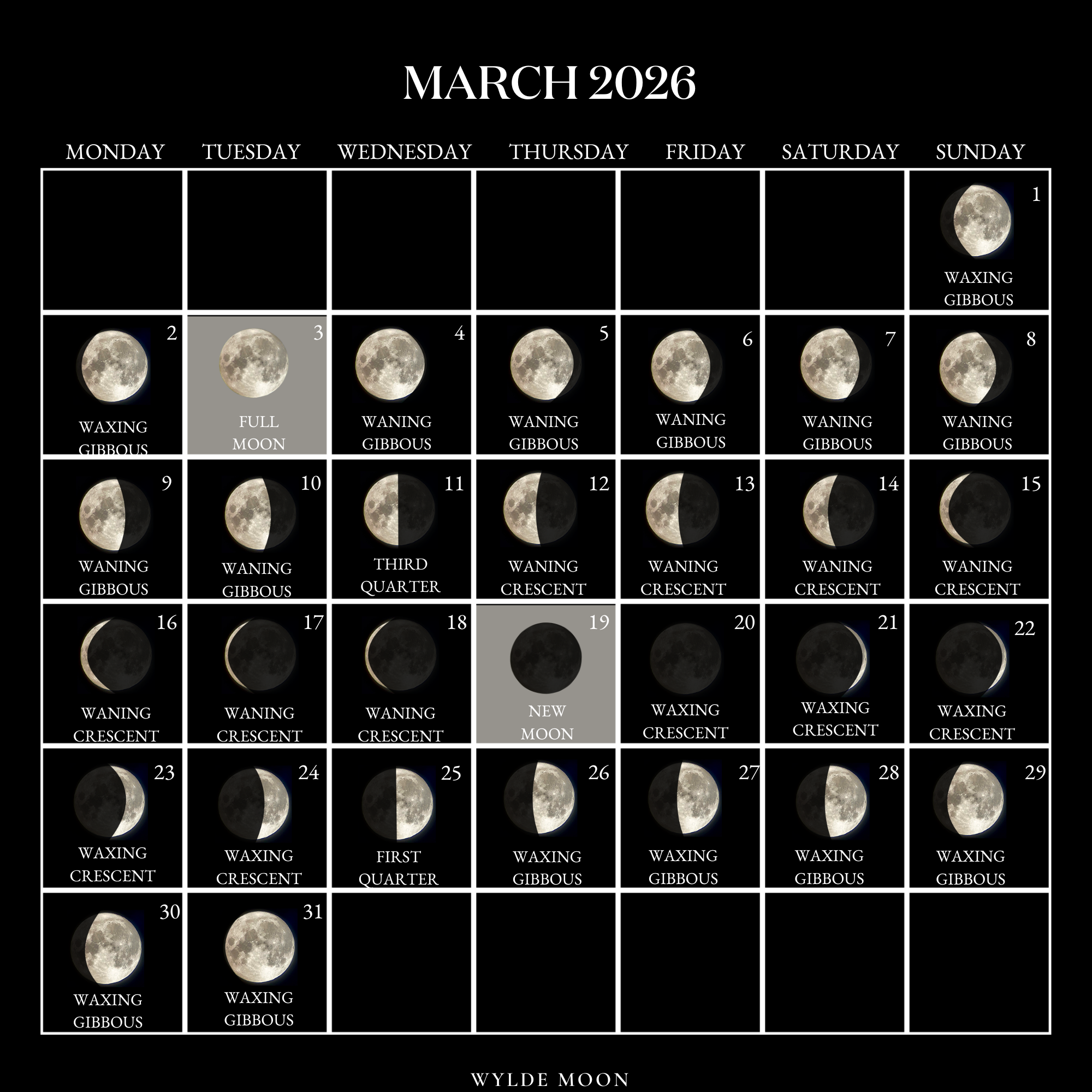
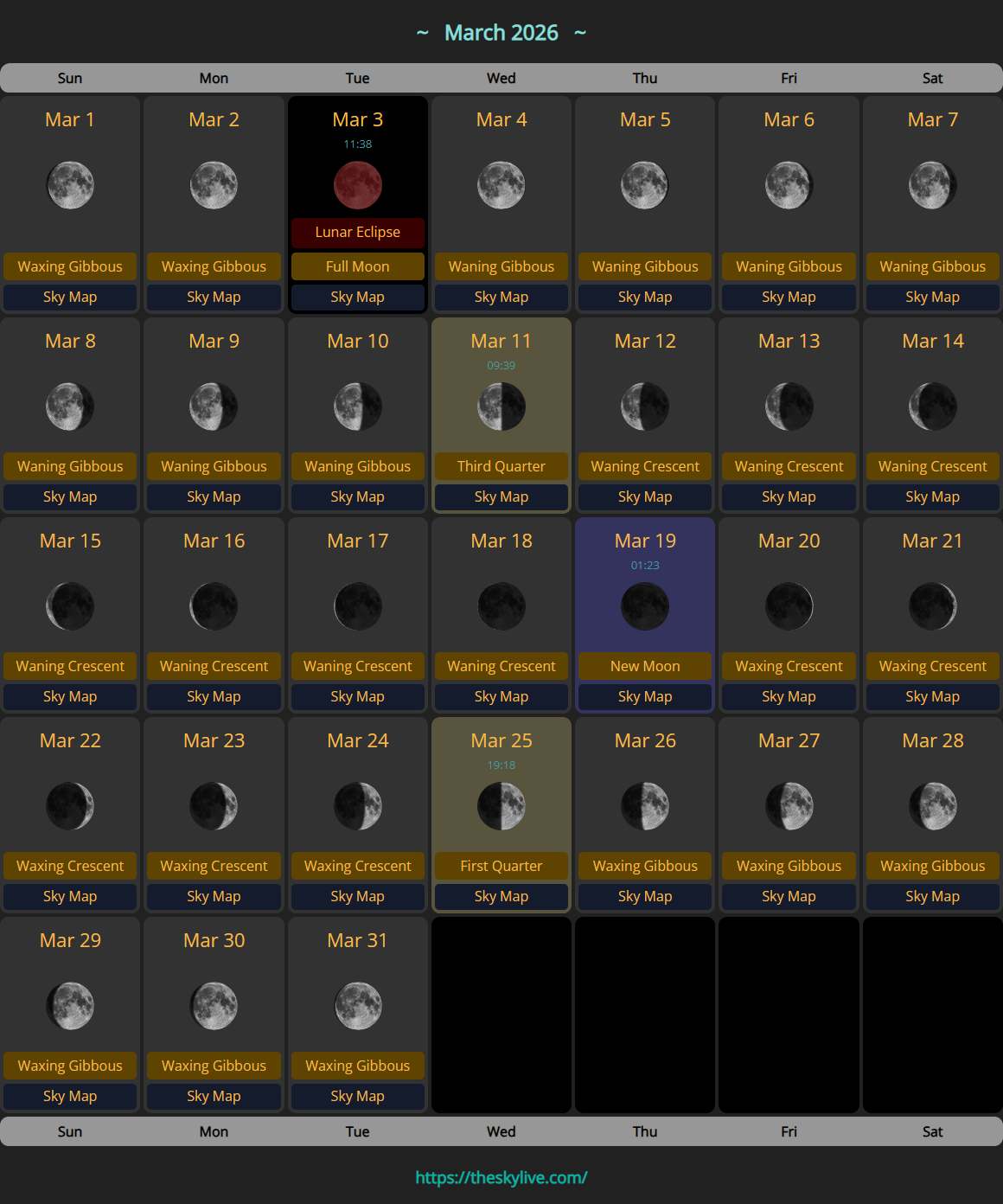
March 2026 Lunar Calendar: All Moon Phases at a Glance
Beyond the spectacular Full Moon and eclipse, the Moon cycles through all its phases each month. Understanding these phases can help you connect more deeply with the natural world and plan your stargazing activities.
Here’s a complete breakdown of the Moon phases for March 2026, with times adjusted for Eastern Standard Time (EST):
| Date | Moon Phase | Time (EST) | Notes |
|---|---|---|---|
| March 1 | Waxing Gibbous | Growing towards full illumination | |
| March 3 | Full Moon | 6:38 AM | Total Lunar Eclipse! (Peak illumination for Worm Moon) |
| March 4 | Waning Gibbous | Starting to decrease in illumination | |
| March 11 | Last Quarter | 11:15 AM | Half-moon phase, lit on the left side |
| March 19 | New Moon | 10:59 PM | Moon not visible from Earth, ideal for stargazing |
| March 26 | First Quarter | 3:10 PM | Half-moon phase, lit on the right side |
| March 31 | Waxing Gibbous | Approaching April’s Full Moon |
Understanding these phases helps you appreciate the Moon’s consistent, yet ever-changing, presence in our night sky. The New Moon, for instance, is often the best time for observing faint deep-sky objects, as there’s no lunar glare.
Why Do We Track the Moon? Beyond the Calendar
Tracking the Moon is far more than just knowing when the next full moon is. For millennia, humanity has looked to our lunar companion for guidance, inspiration, and understanding. Its rhythm deeply influences our planet and our lives.
Cultural and Historical Significance
From the earliest civilizations, the Moon has been an indispensable tool. Ancient cultures used lunar calendars to mark seasons, predict tides, and plan agricultural cycles. Many religious festivals and holidays around the world are still determined by lunar phases.

- Agriculture: Farmers historically observed moon phases for optimal planting and harvesting times, believing the moon’s gravitational pull affected plant growth.
- Navigation: Sailors relied on lunar cycles to understand tidal patterns, crucial for safe passage.
- Folklore and Mythology: The Moon is central to countless myths, legends, and spiritual practices, often associated with femininity, mystery, and transformation.
Modern-Day Relevance
Even in our technologically advanced age, the Moon continues to hold relevance:
- Astronomy Enthusiasts: For amateur and professional astronomers, the lunar cycle dictates observing schedules, particularly for deep-sky objects during New Moon phases.
- Gardening and Biodynamics: Some gardeners still follow lunar planting calendars, aligning their activities with specific moon phases for perceived better yields.
- Personal Reflection and Wellness: Many individuals use the Full Moon as a time for release, intention setting, and personal reflection, tapping into its symbolic power.
- Tidal Forces: The Moon’s gravitational pull remains the primary driver of Earth’s ocean tides, influencing coastal ecosystems and human activities.
Debunking Moon Myths and Misconceptions
With such a powerful and visible object in our sky, it’s no wonder that countless myths and misconceptions have grown around the Full Moon. While fascinating, it’s important to separate folklore from scientific fact.
Common Full Moon Folklore vs. Science
You’ve likely heard claims that the Full Moon causes increased crime rates, more hospital admissions, or even makes people act erratically – hence the term “lunacy.”
- Increased Crime/Hospital Visits: Despite popular belief, numerous scientific studies have found no consistent correlation between the full moon and these phenomena. Any perceived increase is often attributed to confirmation bias – we’re more likely to remember unusual events that happen during a full moon.
- Sleep Disruption: Some research suggests that the full moon might slightly affect sleep patterns in some individuals, possibly due to light exposure or subtle biological rhythms, but this effect is generally minor and not universally experienced.
- Behavioral Changes: While the moon’s gravitational pull certainly affects tides, its influence on individual human behavior is negligible. The human body is mostly water, but the scale of the moon’s pull on such a small mass is too tiny to cause significant behavioral shifts.
While it’s fun to explore these tales, the true magic of the Moon lies in its predictable cycles, its stunning beauty, and the profound scientific phenomena it presents, like the upcoming Total Lunar Eclipse.
Prepare for the Next Full Moon in 2026
After the excitement of the March Worm Moon and its total lunar eclipse, the celestial show continues. The next full moon of 2026 will be the Pink Moon in April. Each full moon offers a unique opportunity to connect with the night sky and observe Earth’s enduring lunar companion.
Make a note of these dates, set your alarms, and prepare to step outside. Whether you’re an avid astronomer or simply curious about the cosmos, the March 2026 Full Moon and its accompanying Total Lunar Eclipse promise an unforgettable experience. It’s a rare chance to witness our solar system in action, painting the night sky with beauty and wonder. Don’t miss it!
Frequently Asked Questions
When is the Full Moon in March 2026?
The Full Moon in March 2026, traditionally known as the Worm Moon, will occur on Tuesday, March 3, 2026, with peak illumination at 6:38 AM EST (3:38 AM PST).
Will there be a Lunar Eclipse in March 2026?
Yes, there will be a spectacular Total Lunar Eclipse accompanying the March 2026 Full Moon. It will be visible across the Americas, the Pacific, and parts of Asia and Australia, occurring during the late night of March 2nd and early morning of March 3rd in the USA.
What is the ‘Worm Moon’?
The ‘Worm Moon’ is the traditional name for the March Full Moon, historically attributed to Native American tribes and early colonists. It signifies the thawing of the ground after winter, allowing earthworms to emerge, and signaling the approach of spring.
Do I need special equipment to view the Total Lunar Eclipse?
No, a Total Lunar Eclipse is perfectly safe to view with the naked eye. You do not need any special filters or equipment. Binoculars or a small telescope can enhance the view and reveal more details on the Moon’s surface.
What time will the Total Lunar Eclipse be visible in the USA?
The Total Lunar Eclipse will begin its total phase around 4:00 AM EST (1:00 AM PST) on March 3rd, 2026, reaching its maximum eclipse around 4:45 AM EST (1:45 AM PST). The entire event, from penumbral to penumbral, will span several hours.
What other moon phases occur in March 2026?
Besides the Full Moon on March 3rd, March 2026 will also feature a Last Quarter Moon on March 11th, a New Moon on March 19th, and a First Quarter Moon on March 26th, alongside the waxing and waning gibbous/crescent phases.
