Full Moon Schedule March 2026: The Worm Moon, A Total Lunar Eclipse, and Your Ultimate Guide
Get ready for a truly special March 2026! This isn’t just any month for moon gazers; it features a spectacular Full Moon that also happens to coincide with a total lunar eclipse. If you’re here for the precise dates, times, and everything you need to know to experience this celestial show, you’ve come to the right place. We’re breaking down all the lunar action for March 2026, from the exact moment of the Full Moon to how you can witness the rare ‘Blood Moon’ event.
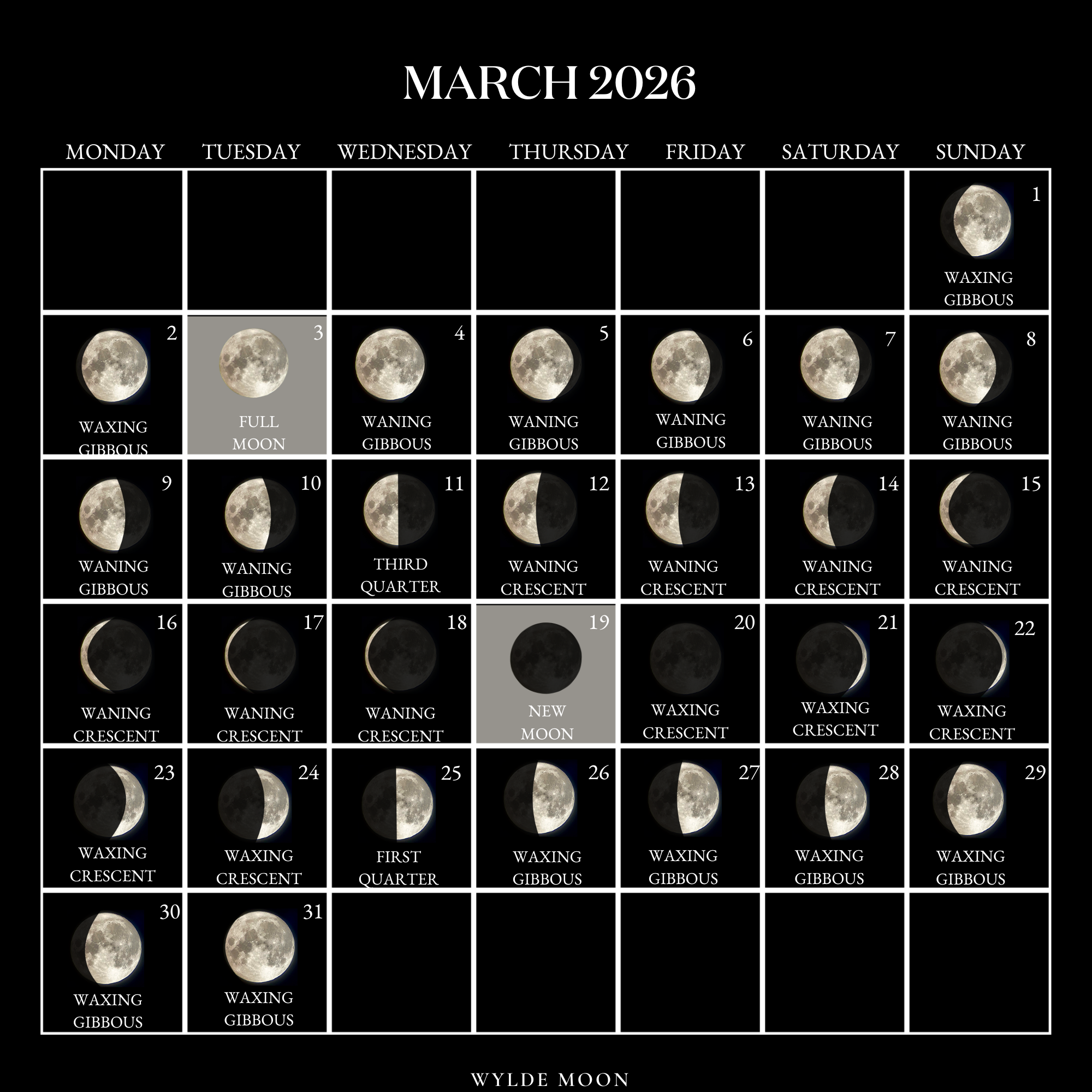
So, mark your calendars and prepare your viewing spots:
- Full Moon Date: Tuesday, March 3, 2026
- Peak Illumination (UTC): 11:38 AM UTC
- Traditional Name: The Worm Moon
- Special Event: Total Lunar Eclipse
Let’s dive into the details so you don’t miss a single moment!
The March 2026 Full Moon: Date, Time & Details
The stellar centerpiece of March 2026 is undoubtedly the Full Moon, affectionately known as the Worm Moon. It will reach its peak illumination on Tuesday, March 3, 2026. For those of us in the United States, this means a dazzling spectacle unfolding in the early morning hours, perfect for a pre-dawn observation.
Understanding the exact time is crucial for planning your viewing. Below, we’ve broken down the peak illumination across various U.S. time zones, alongside the universal UTC time, so you can pinpoint the moment of maximum lunar glory:

| Event | Date (UTC) | Time (UTC) | Time (EST) | Time (CST) | Time (MST) | Time (PST) | Traditional Name | Astrological Sign |
|---|---|---|---|---|---|---|---|---|
| Full Moon Peak | March 3, 2026 | 11:38 AM | 6:38 AM | 5:38 AM | 4:38 AM | 3:38 AM | Worm Moon | Virgo |
What Exactly Is a Full Moon?
Beyond the mystical allure, a Full Moon is a specific astronomical event. It occurs when the Moon is directly opposite the Sun in its orbit around Earth. From our perspective on Earth, this alignment causes the entire face of the Moon to be illuminated by the Sun’s light, creating the brilliant, perfectly round orb we associate with a Full Moon. While the “peak” is an exact second, the Moon will appear full to the naked eye for about a day before and after this precise moment.

Unveiling the Worm Moon: March’s Traditional Full Moon Name
Every Full Moon carries a traditional name, often rooted in the agricultural cycles and natural phenomena observed by indigenous cultures and early settlers. The March Full Moon is widely known as the Worm Moon, and its origin is both fascinating and deeply connected to the changing seasons.

Why ‘Worm Moon’? The Signs of Spring
The name ‘Worm Moon’ heralds the arrival of spring. As the ground thaws after the long winter, earthworms begin to emerge from the soil. This movement of worms is a vital sign for birds and other animals that winter is receding and new life is returning. For early peoples, it signaled a time when the ground was becoming workable again, when animals were waking up, and when food sources would soon replenish.
It’s a beautiful, naturalistic reminder that even a celestial event is intimately linked to life on Earth.
Other Names for March’s Full Moon
While ‘Worm Moon’ is the most common, different cultures and regions had their own names for the March Full Moon, reflecting their unique environments and observations:
- Sap Moon: Reflecting the flow of maple sap in preparation for sugaring season.
- Crow Moon: Signaling the return of crows after winter, a harbinger of spring.
- Lenten Moon: In Christian traditions, this moon often falls during the season of Lent.
- Crust Moon: Referring to the crust that forms on top of snow as it thaws by day and freezes by night.
These names paint a vivid picture of a world much more attuned to the rhythms of nature, and they enrich our understanding of the celestial body above us.
A Rarity in the Skies: The March 2026 Total Lunar Eclipse
What makes the March 2026 Full Moon exceptionally special is its rare alignment with a total lunar eclipse! This isn’t just a bright, pretty moon; it’s a celestial showstopper. Lunar eclipses occur when the Earth passes directly between the Sun and the Moon, casting a shadow on our lunar neighbor. A total lunar eclipse, often called a ‘Blood Moon’, happens when the Moon is fully immersed in the darkest part of Earth’s shadow (the umbra).
Instead of disappearing, the Moon takes on a dramatic reddish or coppery hue. This happens because some sunlight, refracted and scattered by Earth’s atmosphere, still reaches the Moon’s surface. Think of all the sunrises and sunsets happening simultaneously on Earth – that reddish light is what illuminates the eclipsed Moon.
When and Where to See It: Best Visibility in the USA
The March 2026 Total Lunar Eclipse will be visible across North and South America, as well as parts of Europe and Africa. For viewers in the United States, the eclipse will unfold in the pre-dawn hours of Tuesday, March 3rd, making it a spectacular, albeit early, event to witness.
The maximum eclipse, where the Moon is deepest in Earth’s shadow and appears its reddest, will occur very close to the peak Full Moon time. Here’s a general guide to the key phases:
| Eclipse Phase | Approximate Time (UTC) | Approximate Time (EST) | Approximate Time (PST) | Description |
|---|---|---|---|---|
| Penumbral Eclipse Begins | 09:40 AM | 04:40 AM | 01:40 AM | Moon enters Earth’s faint outer shadow. Subtle darkening may be visible. |
| Partial Eclipse Begins | 10:40 AM | 05:40 AM | 02:40 AM | Moon enters Earth’s dark inner shadow (umbra). A noticeable ‘bite’ appears. |
| Total Eclipse Begins | 11:30 AM | 06:30 AM | 03:30 AM | Moon is fully within the umbra; ‘Blood Moon’ effect is visible. |
| Maximum Eclipse | 12:08 PM | 07:08 AM | 04:08 AM | Deepest red color, most dramatic view. |
| Total Eclipse Ends | 12:45 PM | 07:45 AM | 04:45 AM | Moon begins to exit the umbra; brightness returns. |
| Partial Eclipse Ends | 01:45 PM | 08:45 AM | 05:45 AM | Moon fully exits the umbra. |
| Penumbral Eclipse Ends | 02:45 PM | 09:45 AM | 06:45 AM | Eclipse concludes. |
Important Note: Lunar eclipses are completely safe to view with the naked eye! Unlike solar eclipses, you don’t need any special protective eyewear. Just find a clear view of the moon and enjoy the spectacle.
Decoding All Moon Phases in March 2026
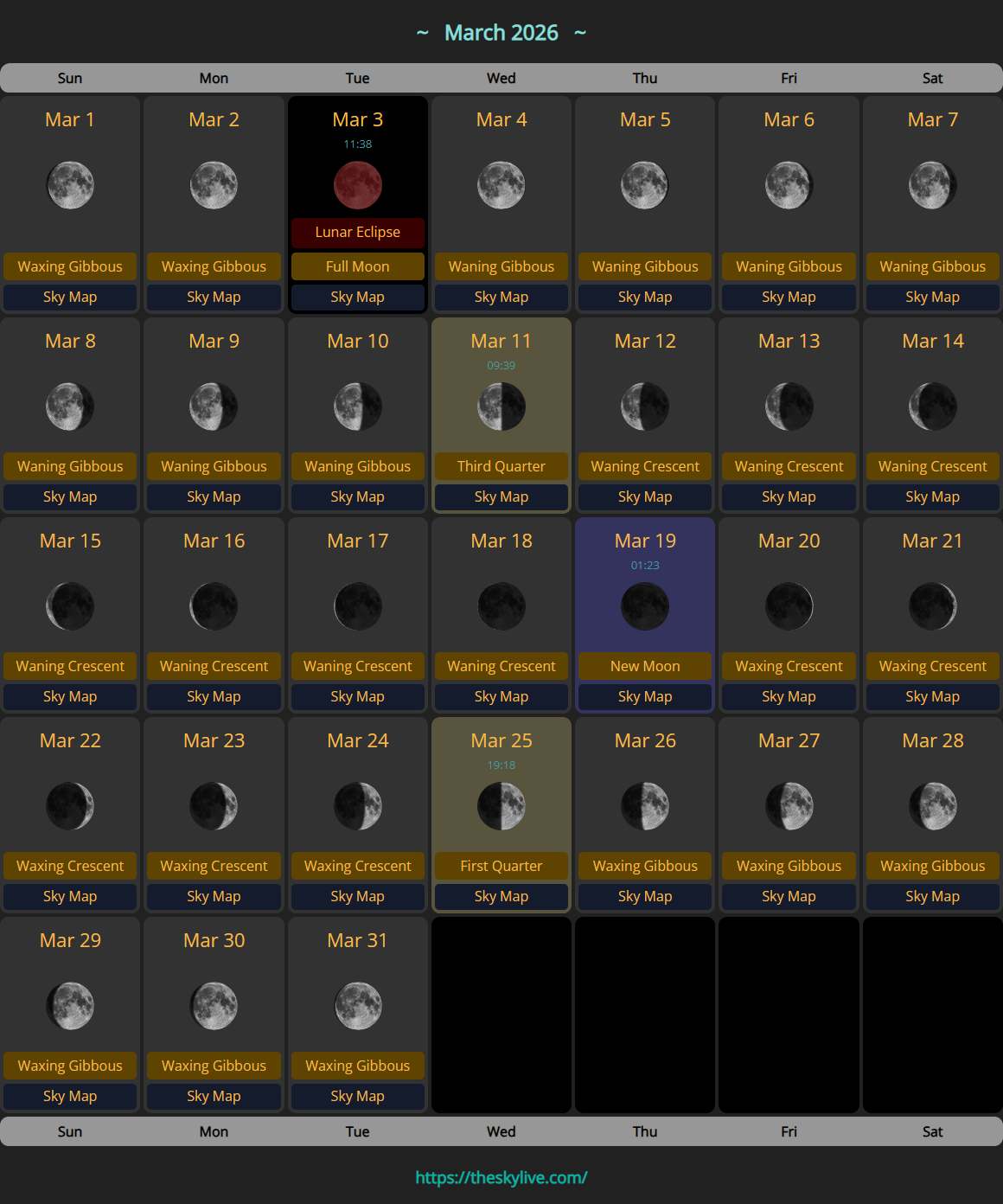
While the Full Moon and total lunar eclipse steal the spotlight, the Moon cycles through all its beautiful phases throughout March. Understanding this rhythm allows you to appreciate the changing lunar landscape every night.
Here’s a comprehensive look at all the major Moon phases for March 2026, including their illumination percentages and astrological signs. This table is your go-to reference for every lunar event this month:
| Date (UTC) | Moon Phase | Time (UTC) | Illumination % | Astrological Sign | Key Event / Notes |
|---|---|---|---|---|---|
| March 1 | Waxing Gibbous | ~00:00 AM | 95% | Leo/Virgo | Approaching Fullness |
| March 3 | Full Moon | 11:38 AM | 100% | Virgo | Worm Moon & Total Lunar Eclipse! |
| March 5 | Waning Gibbous | ~00:00 AM | 95% | Libra | Starting to recede |
| March 11 | Last Quarter | 05:00 AM | 50% | Capricorn | Half-lit, visible in morning sky |
| March 15 | Waning Crescent | ~00:00 AM | 15% | Aquarius | Thin sliver |
| March 19 | New Moon | 01:00 PM | 0% | Pisces | Moon invisible to naked eye |
| March 23 | Waxing Crescent | ~00:00 AM | 20% | Aries | First visible sliver returns |
| March 26 | First Quarter | 09:00 PM | 50% | Cancer | Half-lit, visible in evening sky |
| March 30 | Waxing Gibbous | ~00:00 AM | 85% | Leo | Approaching next Full Moon |
Understanding the Lunar Cycle
The Moon’s phases are a continuous cycle driven by its orbit around Earth and the changing angles at which we view the sunlit portion. Here’s a quick refresher:
- New Moon: The Moon is between the Earth and the Sun, making it invisible to us. A fresh cycle begins!
- Waxing Crescent: A thin sliver of light appears on the right side of the Moon, growing larger each night.
- First Quarter: Exactly half of the Moon’s face is lit, resembling a ‘D’ shape in the Northern Hemisphere. It’s roughly one-quarter of the way through its orbit.
- Waxing Gibbous: More than half, but not yet fully illuminated, growing towards the Full Moon.
- Full Moon: The entire face of the Moon is lit.
- Waning Gibbous: The illumination begins to recede from the right side, getting smaller.
- Last Quarter: The other half of the Moon is lit, resembling a ‘C’ shape in the Northern Hemisphere.
- Waning Crescent: A thin sliver remains, shrinking until it disappears back into the New Moon.
How to Best Observe the March 2026 Full Moon and Eclipse
Ready to make the most of March’s lunar offerings? Here’s how to ensure you have the best possible viewing experience, especially with the added bonus of a total lunar eclipse:
Finding the Best Spot
For any celestial event, location is key:
- Seek Dark Skies: While the Full Moon is bright, escaping city light pollution will enhance its beauty and make the subtle reddish hues of the eclipse stand out. Rural areas, national parks, or even a backyard far from streetlights are ideal.
- Clear Horizon: Since the Full Moon and eclipse will occur in the early morning for many in the U.S., make sure you have an unobstructed view of the western horizon as the Moon will be setting. Conversely, if observing the earlier phases of the eclipse, look to the west.
- Elevated Views: If possible, a spot with a slight elevation can help clear any local obstructions like trees or buildings.
Essential Gear (Optional, but Recommended)
Good news: you don’t need fancy equipment to enjoy a lunar eclipse!
- Naked Eye: The ‘Blood Moon’ effect is perfectly visible with your unaided eyes. You’ll see the color change vividly.
- Binoculars: For a more detailed look at the Moon’s surface, its craters, and to truly appreciate the subtle shifts in color during the eclipse, a pair of binoculars (7×50 or 10×50 are great all-rounders) will make a huge difference.
- Telescope: If you have one, a telescope will offer stunning close-ups of the lunar landscape, enhancing the sense of being there. However, for the overall eclipse effect, binoculars might actually provide a more encompassing view of the Moon’s entire disc in its reddish glow.
Tips for Viewing Success
- Check Local Weather: Keep an eye on the forecast for March 3rd. Clear skies are your best friend!
- Dress Warmly: Early mornings in March can still be chilly, especially if you’re standing outside for an extended period.
- Set Your Alarm: Don’t forget those early morning times! Plan to be ready and observing at least 30 minutes before the total eclipse phase begins to witness the progression.
- Photography: If you’re hoping to capture the eclipse, you’ll need a camera with manual settings, a sturdy tripod, and possibly a telephoto lens. Experiment with long exposures to capture the subtle reddish light.
- Share the Moment: Lunar eclipses are fantastic events to enjoy with family and friends. Gather your loved ones and share the wonder!
Looking Ahead: Full Moons Immediately Before and After March 2026
The lunar calendar is a continuous dance, and understanding the context of March’s Full Moon involves looking at its neighbors. Here’s a brief look at the Full Moons that bookend the March 2026 event:
| Month | Full Moon Name | Date (UTC) | Time (UTC) | Astrological Sign |
|---|---|---|---|---|
| February 2026 | Snow Moon | February 1 | 22:09 PM | Leo |
| March 2026 | Worm Moon | March 3 | 11:38 AM | Virgo |
| April 2026 | Pink Moon | April 2 | 02:12 AM | Libra |
A Glimpse into the Future: All 2026 Full Moon Dates
For the avid skywatcher, planning ahead is half the fun! Here’s the complete schedule of all Full Moons throughout 2026, so you can keep your lunar calendar updated and never miss a brilliant night sky event.
| Month | Full Moon Name | Date (UTC) | Time (UTC) | Astrological Sign |
|---|---|---|---|---|
| January | Wolf Moon | January 3 | 10:03 AM | Cancer |
| February | Snow Moon | February 1 | 22:09 PM | Leo |
| March | Worm Moon | March 3 | 11:38 AM | Virgo |
| April | Pink Moon | April 2 | 02:12 AM | Libra |
| May | Flower Moon | May 1 | 07:12 PM | Scorpio |
| June | Strawberry Moon | May 31 | 11:30 PM | Sagittarius |
| July | Buck Moon | July 1 | 1:18 PM | Capricorn |
| August | Sturgeon Moon | July 31 | 04:50 AM | Aquarius |
| September | Harvest Moon | August 29 | 09:40 PM | Pisces |
| October | Hunter’s Moon | September 28 | 02:30 PM | Aries |
| November | Beaver Moon | October 27 | 08:50 AM | Taurus |
| December | Cold Moon | November 25 | 04:00 AM | Gemini |
Please note: Dates and times are for the precise moment of full illumination/phase change in UTC. Local times will vary by your time zone. Astrological signs indicate the constellation the Moon is passing through at the moment of the phase.
Conclusion: Embrace the Lunar Magic of March 2026
March 2026 isn’t just another month on the calendar; it’s a celestial invitation! From the humble significance of the ‘Worm Moon’ heralding spring to the breathtaking spectacle of a total lunar eclipse turning our Moon a dramatic red, there’s so much to look forward to. Whether you’re an avid astronomer or simply enjoy gazing at the night sky, this month offers a unique opportunity to connect with the cosmos.
So, set your alarms, check the weather, and prepare to witness one of nature’s most enchanting displays. The universe is putting on a show, and you’ve got the front-row seat!
”
Frequently Asked Questions
When is the Full Moon in March 2026?
The Full Moon in March 2026, traditionally known as the Worm Moon, will occur on Tuesday, March 3, 2026. Its peak illumination is at 11:38 AM UTC (6:38 AM EST).
What is special about the March 2026 Full Moon?
The March 2026 Full Moon is exceptionally special because it coincides with a total lunar eclipse, often referred to as a ‘Blood Moon’. This rare event will see the Moon turn a dramatic reddish-orange hue as it passes through Earth’s shadow.
What time will the total lunar eclipse be visible in the USA?
The total lunar eclipse on March 3, 2026, will be visible in the early morning across the United States. The total eclipse phase is expected to begin around 06:30 AM EST (03:30 AM PST), with maximum eclipse around 07:08 AM EST (04:08 AM PST).
What is the ‘Worm Moon’?
The ‘Worm Moon’ is the traditional name for the Full Moon in March. It signifies the thawing of the ground after winter, which causes earthworms to reappear, signaling the return of spring and a new cycle of life.
Do I need special equipment to view the total lunar eclipse?
No, you do not need any special equipment or protective eyewear to safely view a total lunar eclipse. It is completely safe to observe with the naked eye. Binoculars or a telescope can enhance the view of the Moon’s surface and the eclipse’s color variations, but are not necessary.
What are the other major Moon phases in March 2026?
Besides the Full Moon on March 3, the other major Moon phases in March 2026 include the Last Quarter Moon on March 11, the New Moon on March 19, and the First Quarter Moon on March 26. Each phase offers a unique viewing experience.
