March 2026 Full Moon: The Worm Moon, a Total Lunar Eclipse, and Your Ultimate Guide
Ever feel a pull towards the night sky? That undeniable urge to gaze up at our closest celestial neighbor? If you do, mark your calendars, because the March 2026 Full Moon is going to be an absolutely unforgettable event. It’s not just any full moon; it’s the mystical Worm Moon, and here’s the kicker: it coincides with a rare and spectacular Total Lunar Eclipse! Imagine the Moon transforming into a stunning & ;Blood Moon& ; right before your eyes. You absolutely won’t want to miss this.
Forget generic calendar entries. We’re diving deep into everything you need to know & ; the exact date and times, where in the USA you can see the eclipse, the fascinating story behind the Worm Moon name, and how to get the most out of this truly special celestial show.
The March 2026 Full Moon: Date, Time, and a Celestial Spectacle
Let’s get straight to the point. When exactly is this incredible event happening? You’ll be looking up at the fully illuminated Worm Moon as it undergoes a total lunar eclipse in the early morning hours of Tuesday, March 3, 2026.
When is the March 2026 Full Moon?
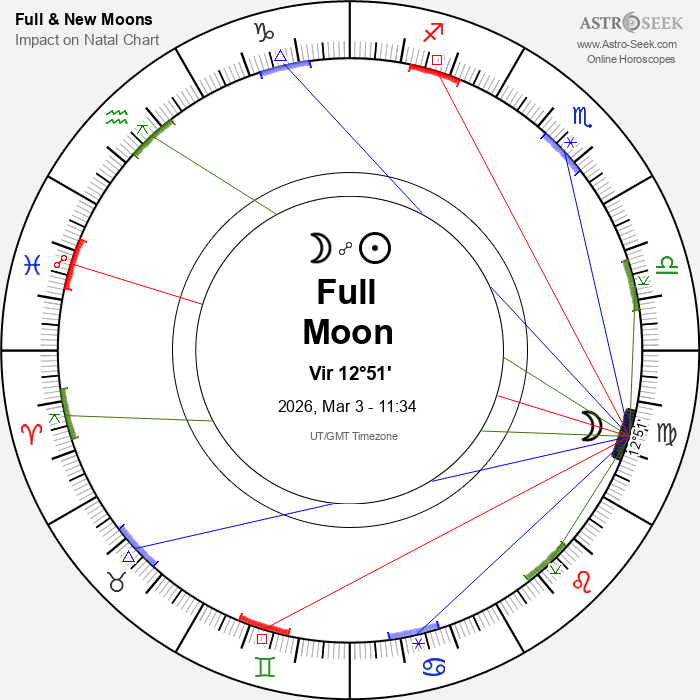
The Moon will reach its peak fullness at 11:38 AM Universal Coordinated Time (UTC) on March 3, 2026. For those of us in the United States, this translates to the pre-dawn and early morning hours across the country. This timing is perfect for a truly memorable viewing experience, especially with the eclipse unfolding.
| Event | Date (UTC) | Time (UTC) | Time (EST) | Time (CST) | Time (MST) | Time (PST) | Traditional Name |
|---|---|---|---|---|---|---|---|
| Full Moon Peak | March 3, 2026 | 11:38 AM | 6:38 AM | 5:38 AM | 4:38 AM | 3:38 AM | Worm Moon |
But Wait, There’s More: A Total Lunar Eclipse!
What makes the March 2026 Full Moon truly exceptional is its alignment with a Total Lunar Eclipse. This isn’t just a pretty moon; it’s a dynamic celestial event where the Earth positions itself directly between the Sun and the Moon, casting a shadow that slowly darkens and often reddens our lunar companion. Unlike a solar eclipse, which requires special eye protection, a lunar eclipse is perfectly safe to view directly and offers a breathtaking spectacle.
This means that as you observe the Worm Moon reach its peak illumination, you’ll also be watching it undergo a dramatic transformation, from bright white to a deep, ruddy & ;Blood Moon.& ; It’s a fantastic opportunity to witness the mechanics of our solar system in action.
Decoding the “Worm Moon”: Name, Lore, and Seasonal Significance
Every full moon carries a traditional name, often rooted in Native American, Colonial American, or European folklore, reflecting the changing seasons and natural world. The March Full Moon is famously known as the Worm Moon.
The Origin of the “Worm Moon” Name
The name & ;Worm Moon& ; hails from a time when people lived in closer harmony with nature& ;s rhythms. As winter’s icy grip begins to loosen and the ground thaws, earthworms start to emerge from their subterranean slumber. This signals the return of robins and other birds, a sure sign that spring is truly on its way.

For many indigenous tribes and early settlers, the appearance of the Worm Moon was a hopeful beacon, marking the end of scarcity and the beginning of new life, planting, and abundance. It& ;s a beautiful reminder of nature’s cyclical regeneration.
Other Names for the March Full Moon
While & ;Worm Moon& ; is the most popular, this full moon has been known by other evocative names across different cultures:
- Sugar Moon or Sap Moon: Used by some Native American tribes, referring to the time when maple sap begins to flow, perfect for making syrup.
- Crow Moon: Reflecting the return of crows as the winter retreats.
- Lenten Moon: A name with European origins, coinciding with the Christian fasting period of Lent.
Regardless of its name, the March Full Moon consistently symbolizes renewal, awakening, and the promise of warmer, more fertile days ahead.
Witnessing the Total Lunar Eclipse of March 2026: Your Viewing Guide
This is where the March 2026 Full Moon truly stands out. A total lunar eclipse is a breathtaking event, and the fact that it coincides with the Full Worm Moon makes it even more special. Here& ;s what you need to know to experience it fully.
What is a Total Lunar Eclipse?
A total lunar eclipse occurs when the Earth passes precisely between the Sun and the Moon, casting a full shadow (the umbra) over the Moon. Instead of disappearing completely, the Moon often takes on a reddish-orange hue, earning it the nickname & ;Blood Moon.& ; This happens because sunlight, filtered through Earth& ;s atmosphere, bends and scatters blue light more effectively, leaving the red and orange wavelengths to illuminate the Moon. It’s essentially seeing all the world’s sunrises and sunsets projected onto the Moon’s surface!
Visibility and Timing for the USA
Good news for skywatchers across the United States: the Total Lunar Eclipse of March 2026 will be visible from all of North America, assuming clear skies. The key is to know the timings for your specific time zone. Since the peak of the eclipse (and the full moon) occurs in the early morning hours of March 3rd, set your alarms!
| Eclipse Stage | Time (UTC) | Time (EST) | Time (CST) | Time (MST) | Time (PST) |
|---|---|---|---|---|---|
| Penumbral Eclipse Begins | March 3, 09:12 AM | March 3, 4:12 AM | March 3, 3:12 AM | March 3, 2:12 AM | March 3, 1:12 AM |
| Partial Eclipse Begins | March 3, 10:12 AM | March 3, 5:12 AM | March 3, 4:12 AM | March 3, 3:12 AM | March 3, 2:12 AM |
| Total Eclipse Begins | March 3, 11:12 AM | March 3, 6:12 AM | March 3, 5:12 AM | March 3, 4:12 AM | March 3, 3:12 AM |
| Maximum Eclipse | March 3, 11:42 AM | March 3, 6:42 AM | March 3, 5:42 AM | March 3, 4:42 AM | March 3, 3:42 AM |
| Total Eclipse Ends | March 3, 12:12 PM | March 3, 7:12 AM | March 3, 6:12 AM | March 3, 5:12 AM | March 3, 4:12 AM |
| Partial Eclipse Ends | March 3, 13:12 PM | March 3, 8:12 AM | March 3, 7:12 AM | March 3, 6:12 AM | March 3, 5:12 AM |
| Penumbral Eclipse Ends | March 3, 14:12 PM | March 3, 9:12 AM | March 3, 8:12 AM | March 3, 7:12 AM | March 3, 6:12 AM |
Important Note: For those on the East Coast, the total eclipse phase will be happening as dawn breaks. The Moon will be lower in the western sky, potentially making for a dramatic backdrop if you have a clear view of the horizon. Western viewers will experience the eclipse well before sunrise, with the Moon higher in the sky.
Tips for Observing the Eclipse
One of the best things about a lunar eclipse is how accessible it is. You don’t need fancy equipment to enjoy the show, but a few tips can enhance your experience:
- Find a Clear View: Look for an unobstructed view of the western sky, especially if you’re on the East Coast. Away from city lights is always best for any celestial event.
- No Special Equipment Needed: Unlike a solar eclipse, it’s perfectly safe to look directly at a lunar eclipse with your naked eyes.
- Binoculars or a Small Telescope: While not essential, binoculars or a small telescope will give you a closer, more detailed look at the Moon’s surface as the Earth’s shadow creeps across it, and enhance the reddish hue.
- Bundle Up: Since this is happening in early March and in the pre-dawn hours, it will likely be chilly. Dress warmly!
- Capture the Moment: Your smartphone camera can capture decent shots of the Blood Moon, especially if you have a tripod or a steady hand. For better results, a DSLR camera with a telephoto lens is ideal. Experiment with settings like a lower ISO and longer exposure times.
- Make it an Event: Gather friends or family! Sharing the experience makes it even more memorable. Prepare some hot drinks or snacks.
Beyond the Full Moon: All Moon Phases in March 2026
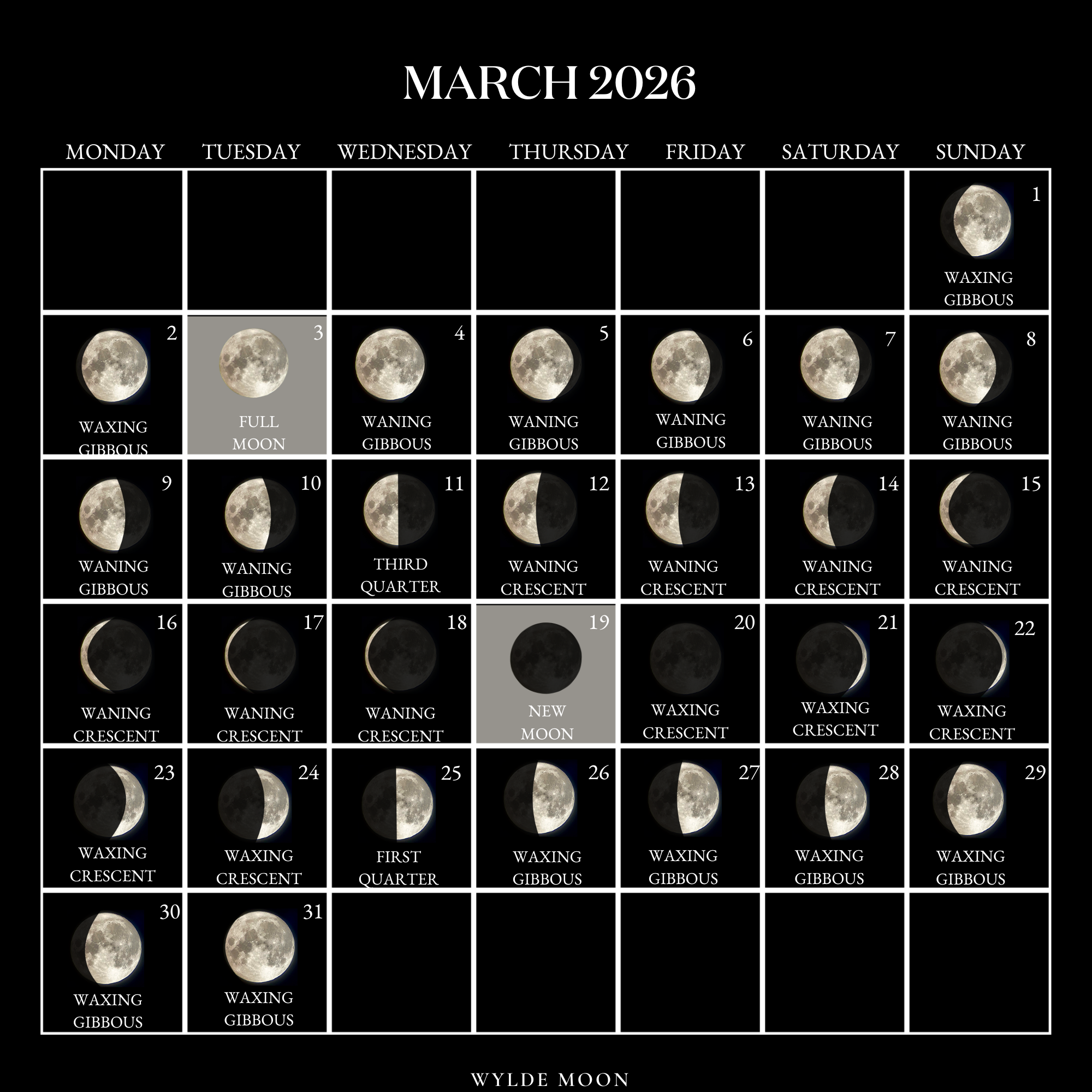
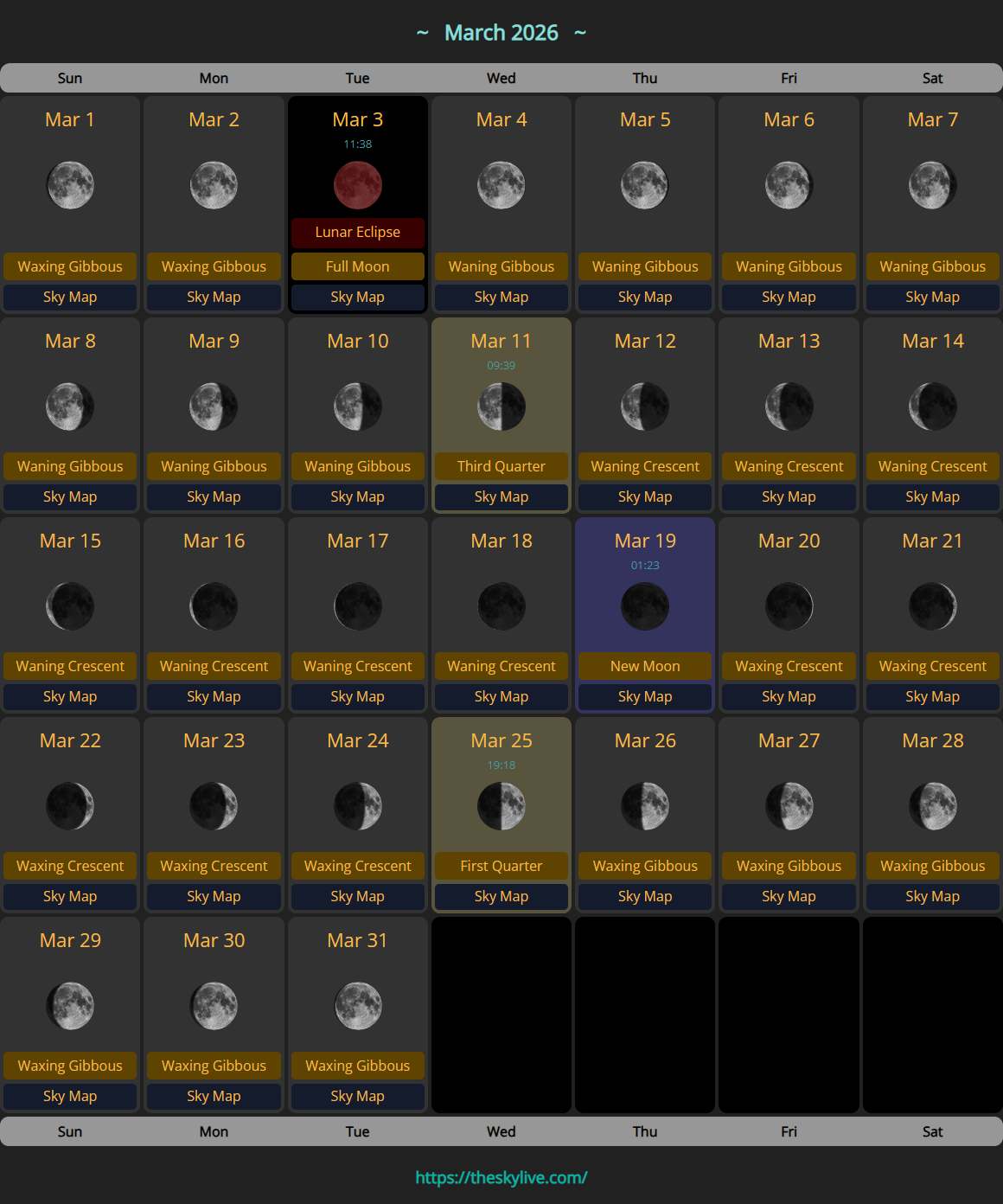
The Full Moon is just one moment in the Moon’s continuous cycle. Throughout March 2026, our lunar companion will display all its beautiful phases. Understanding these phases can enrich your connection to the night sky.
| Date (UTC) | Moon Phase | Time (UTC) | Approx. Illumination |
|---|---|---|---|
| March 1, 2026 | Waxing Gibbous | Evening | ~80-90% |
| March 3, 2026 | Full Moon (Worm Moon, Total Lunar Eclipse) | 11:38 AM | 100% |
| March 11, 2026 | Last Quarter (Third Quarter) | ~10:00 PM | 50% |
| March 18, 2026 | New Moon | ~04:00 PM | 0% |
| March 25, 2026 | First Quarter | ~08:00 AM | 50% |
| March 31, 2026 | Waxing Gibbous | Evening | ~90-95% |
Remember that the terms & ;waxing& ; mean the illuminated portion is growing, and & ;waning& ; means it’s shrinking. A Gibbous moon is more than half illuminated, while a Crescent moon is less than half. The New Moon is essentially invisible from Earth, as its sunlit side faces away from us.
The Full Moons of 2026: A Year of Celestial Wonders
The March Worm Moon with its total lunar eclipse is just one of many opportunities to connect with the night sky in 2026. Each full moon has its own character and traditional name, offering a chance to reflect on the changing seasons and human history. There are even 13 full moons in 2026, meaning we get a rare ‘Blue Moon’!
| Date (UTC) | Time (UTC) | Traditional Name | Special Notes |
|---|---|---|---|
| Jan 3, 2026 | 10:03 AM | Wolf Moon | |
| Feb 1, 2026 | 10:09 PM | Snow Moon | |
| Mar 3, 2026 | 11:38 AM | Worm Moon | Total Lunar Eclipse |
| Apr 2, 2026 | 10:12 PM | Pink Moon | |
| May 1, 2026 | ~08:00 AM | Flower Moon | |
| May 31, 2026 | ~06:00 PM | Blue Moon | Second Full Moon in May |
| Jun 30, 2026 | ~04:00 AM | Strawberry Moon | |
| Jul 29, 2026 | ~02:00 PM | Buck Moon | |
| Aug 28, 2026 | ~11:00 PM | Sturgeon Moon | |
| Sep 27, 2026 | ~09:00 AM | Harvest Moon | Closest to Autumn Equinox |
| Oct 26, 2026 | ~07:00 PM | Hunter’s Moon | |
| Nov 25, 2026 | ~05:00 AM | Beaver Moon | |
| Dec 24, 2026 | ~03:00 PM | Cold Moon |
Keep this calendar handy for a year full of lunar observations!
The Science Behind Lunar Cycles and Eclipses
Understanding the & ;how& ; behind these celestial wonders can make them even more fascinating. It& ;s all about the intricate dance between the Earth, Moon, and Sun.
Why Do We Have Moon Phases?
The Moon doesn’t generate its own light; it simply reflects sunlight. As the Moon orbits the Earth, its position relative to the Sun and Earth changes, altering how much of its sunlit surface we can see from our perspective. This is what creates the familiar phases:
- New Moon: The Moon is between the Earth and the Sun, so its dark side faces us.
- Waxing Crescent: A sliver of light appears, growing larger each night.
- First Quarter: Half of the Moon’s face is illuminated.
- Waxing Gibbous: More than half is lit, growing towards full.
- Full Moon: The Earth is between the Sun and Moon, so the entire face of the Moon is illuminated for us.
- Waning Gibbous: The illumination starts to shrink after the Full Moon.
- Last Quarter (Third Quarter): Again, half the face is illuminated, but on the opposite side from the First Quarter.
- Waning Crescent: A sliver remains, shrinking towards the New Moon.
This entire cycle takes approximately 29.5 days, which is why we typically have one full moon each calendar month.
The Dance of Eclipses: When Sun, Earth, and Moon Align
If full moons happen every month, why don’t we have a lunar eclipse every month? It’s because the Moon’s orbit around the Earth is tilted by about 5 degrees relative to Earth’s orbit around the Sun. Most months, the Moon passes slightly above or below Earth’s shadow.
A lunar eclipse only occurs when the Sun, Earth, and Moon align almost perfectly in a straight line, and the Moon is passing through one of the two & ;nodes& ; & ; the points where its orbit intersects Earth’s orbital plane. When this precise alignment happens during a full moon, the Earth’s shadow falls onto the Moon, giving us a spectacular eclipse.
Embrace the Night Sky: Practical Tips for Stargazers
Observing the March 2026 Full Moon and its accompanying total lunar eclipse is more than just a date on a calendar; it’s an invitation to connect with the cosmos. Here are some general tips to make your stargazing experiences even better:

- Escape Light Pollution: For the best views of dimmer celestial objects (though not strictly necessary for a bright full moon or a Blood Moon), try to get away from city lights. Even a short drive to a rural area can make a huge difference.
- Use Star Charts or Apps: Apps like Stellarium, SkyView Lite, or Google Sky Map can help you identify constellations, planets, and the Moon’s position.
- Allow Your Eyes to Adjust: Give your eyes about 20-30 minutes to adapt to the dark for optimal night vision. Avoid looking at bright screens during this time.
- Red Light is Your Friend: If you need light, use a red-light flashlight. Red light preserves your night vision better than white light.
- Join a Local Astronomy Club: Many communities have astronomy clubs that host public viewing events, often with powerful telescopes and knowledgeable members eager to share their passion.
- Patience is Key: Sometimes clouds roll in, or the view isn’t perfect. Enjoy the moments you do get, and there’s always another celestial event just around the corner.
The March 2026 Full Worm Moon and its total lunar eclipse promise to be a truly special night. From the ancient tales of emerging earthworms to the dramatic spectacle of a Blood Moon, this event offers a rich blend of cultural heritage and scientific wonder. So, set those alarms, find your favorite viewing spot, and prepare to be amazed by the magic unfolding in our night sky. Happy stargazing!
Frequently Asked Questions
When is the Full Moon in March 2026?
The Full Moon in March 2026, known as the Worm Moon, occurs on Tuesday, March 3, 2026, reaching its peak illumination at 11:38 AM Universal Coordinated Time (UTC). For US time zones, this will be in the early morning hours (e.g., 6:38 AM EST, 3:38 AM PST).
What is special about the March 2026 Full Moon?
The March 2026 Full Moon is particularly special because it coincides with a Total Lunar Eclipse. This means that as the Moon reaches its fullest phase, it will pass through Earth’s shadow, transforming into a striking ‘Blood Moon’ visible across North America.
What is the ‘Worm Moon’?
The ‘Worm Moon’ is the traditional name for the March Full Moon. It signifies the beginning of spring, when the ground thaws and earthworms start to emerge, attracting birds and signaling new life. The name has roots in Native American, Colonial American, and European folklore.
Will the Total Lunar Eclipse in March 2026 be visible from the USA?
Yes, the Total Lunar Eclipse of March 2026 will be visible from all of North America, weather permitting. The total phase of the eclipse will occur in the early morning hours of March 3rd, making it an excellent pre-dawn spectacle for many US residents.
Do I need special equipment to view a total lunar eclipse?
No, you do not need any special equipment to view a total lunar eclipse. It is perfectly safe to observe with the naked eye. However, binoculars or a small telescope can enhance the viewing experience, offering a closer look at the Moon’s surface and the changing colors.
What other moon phases occur in March 2026?
In addition to the Full Moon on March 3rd, March 2026 will also feature a Last Quarter Moon around March 11th, a New Moon around March 18th, and a First Quarter Moon around March 25th. The moon will also pass through waxing and waning gibbous/crescent phases throughout the month.
How often do total lunar eclipses happen?
Total lunar eclipses are not exceedingly rare, but they don’t happen every month because the Moon’s orbit is tilted relative to Earth’s orbit around the Sun. We typically experience two to four lunar eclipses of varying types (total, partial, penumbral) each year, with total lunar eclipses occurring roughly once every 1-2 years on average for any given location, though their visibility varies globally.
