March 2026 Full Moon: Your Complete Guide to the Worm Moon & Total Lunar Eclipse
Mark your calendars, celestial enthusiasts! March 2026 isn’t just bringing the annual Worm Moon; it’s ushering in a truly spectacular astronomical event: a total lunar eclipse. If you’ve ever yearned to witness the moon transform into a dramatic shade of red, this is your chance. Forget generic calendars; we’re diving deep into everything you need to know to truly experience this cosmic show.
We’re talking precise timings, cultural significance, and practical observation tips to ensure you don’t miss a single moment. Get ready to connect with the cosmos in a profound way.
The Big Reveal: March 2026 Full Moon Key Details
Let’s cut right to the chase. Here are the essential facts about the March 2026 Full Moon and its accompanying total lunar eclipse:
| Event | Date | Time (UTC) | Time (Eastern Time, ET) | Time (Central Time, CT) | Time (Mountain Time, MT) | Time (Pacific Time, PT) | Traditional Name |
|---|---|---|---|---|---|---|---|
| Full Moon Peak | Tuesday, March 3, 2026 | 11:37 AM | 6:37 AM | 5:37 AM | 4:37 AM | 3:37 AM | Worm Moon |
| Total Lunar Eclipse | Tuesday, March 3, 2026 | See Eclipse Details below | See Eclipse Details below | See Eclipse Details below | See Eclipse Details below | See Eclipse Details below | Blood Moon |
For our friends across the USA, this means an early morning show. You’ll want to set your alarms!

Unpacking the March 2026 Full Moon: The Worm Moon Takes Center Stage
Every full moon carries a story, a connection to the cycles of nature and human history. The March Full Moon is no exception, bearing the delightful and intriguing name: the Worm Moon.
What is the Worm Moon? Origin and Folklore
The name “Worm Moon” isn’t about creepy crawlies emerging from the ground to spook us. Instead, it’s a beautiful, naturalistic moniker rooted in the observations of Native American tribes, particularly those in the northern and eastern parts of the continent. As winter’s grip begins to loosen and the ground thaws, earthworms become active, wriggling to the surface. Their reappearance signals the return of robins and other birds, heralding the true arrival of spring and the possibility of planting crops. It’s a symbol of renewal, awakening, and the promise of new life after a long, dormant season.
Other traditional names for the March Full Moon include the Crow Moon (when crows signal the end of winter), the Sap Moon (tapping maple trees for syrup), and the Crust Moon (referring to the crust that forms on top of snow when it thaws by day and freezes by night).
Astrological Significance: The Virgo Full Moon
For those who follow the celestial whispers, the March 2026 Full Moon will occur in the meticulous and analytical sign of Virgo. Full Moons are always a time of culmination, release, and illumination. When the Moon shines full in Virgo, it brings an energy of refinement, organization, and discernment.

During this period, you might feel a heightened desire to:
- Analyze and organize: Tackle that cluttered space or re-evaluate your routines.
- Focus on health and wellness: Pay attention to your body’s needs and establish healthier habits.
- Reflect and release: Identify what no longer serves your practical, daily life and let it go.
- Seek perfection: While Virgo strives for excellence, remember to balance this with self-compassion.
It’s an opportune time for self-improvement and grounding yourself in practical realities, especially before the chaos of spring truly kicks in.
The Celestial Main Event: March 2026 Total Lunar Eclipse
The real showstopper in March 2026 is the Total Lunar Eclipse that will coincide with the Full Worm Moon. This isn’t just any full moon; it’s a spectacle that transforms our familiar lunar companion into a mesmerizing “Blood Moon.”
What Exactly is a Total Lunar Eclipse?
A lunar eclipse occurs when the Earth positions itself directly between the Sun and the Moon, casting a shadow on the Moon. There are three types: penumbral, partial, and total. A total lunar eclipse is the most dramatic, as the Earth’s shadow completely covers the Moon.
But wait, if the Earth is blocking the sun, why doesn’t the moon just disappear? Ah, that’s where the magic happens! Even when fully immersed in Earth’s shadow, some sunlight still manages to reach the Moon. This light is filtered and refracted by Earth’s atmosphere, scattering blue light and allowing red and orange wavelengths to pass through. It’s the same phenomenon that gives us breathtaking sunrises and sunsets, but in this case, it paints the Moon in stunning hues of crimson, orange, or even dark brown. This is why a total lunar eclipse is often affectionately called a “Blood Moon.”
Eclipse Visibility and Timing (Crucial Data)
For those in the USA, this total lunar eclipse will be a fantastic early morning event, visible across much of North America, South America, Europe, Africa, and parts of Asia and Australia. Here’s your detailed breakdown of the eclipse stages:
| Eclipse Stage | Time (UTC) | Time (ET) | Time (CT) | Time (MT) | Time (PT) |
|---|---|---|---|---|---|
| Penumbral Eclipse Begins | 09:29 AM | 04:29 AM | 03:29 AM | 02:29 AM | 01:29 AM |
| Partial Eclipse Begins | 10:29 AM | 05:29 AM | 04:29 AM | 03:29 AM | 02:29 AM |
| Total Eclipse Begins | 11:15 AM | 06:15 AM | 05:15 AM | 04:15 AM | 03:15 AM |
| Maximum Eclipse (Full Moon Peak) | 11:37 AM | 06:37 AM | 05:37 AM | 04:37 AM | 03:37 AM |
| Total Eclipse Ends | 11:58 AM | 06:58 AM | 05:58 AM | 04:58 AM | 03:58 AM |
| Partial Eclipse Ends | 12:44 PM | 07:44 AM | 06:44 AM | 05:44 AM | 04:44 AM |
| Penumbral Eclipse Ends | 01:44 PM | 08:44 AM | 07:44 AM | 06:44 AM | 05:44 AM |
Important Note: While the penumbral phases (when the moon enters Earth’s fainter outer shadow) are interesting, they are often subtle and hard to discern with the naked eye. The real action begins with the partial eclipse and intensifies during totality. Focus your viewing on the “Total Eclipse Begins” through “Total Eclipse Ends” window for the most dramatic visuals.
How to Safely Observe the Lunar Eclipse
Unlike solar eclipses, which require specialized eye protection, a lunar eclipse is perfectly safe to view directly with the naked eye. You don’t need any fancy equipment, but a few things can enhance your experience:
- Find a Dark Spot: Light pollution can diminish the subtle hues of the eclipsed moon. Head away from city lights if possible.
- Comfort is Key: This is an early morning event for most of the USA. Bring a comfortable chair, a blanket, and a warm drink. Patience is a virtue!
- Binoculars or a Telescope: While not essential, a pair of binoculars or a small telescope will give you a breathtaking, magnified view of the moon’s surface, enhancing the reddish glow and allowing you to observe subtle details.
- Check the Weather: Of course, clear skies are paramount. Keep an eye on your local forecast as the date approaches.
- Photography: If you’re into astrophotography, a lunar eclipse is a fantastic subject. A tripod, a camera with manual settings, and a telephoto lens will yield stunning results.
Embrace the chill, embrace the quiet, and prepare to be awe-struck by the beauty of our celestial neighbor.
Your Comprehensive March 2026 Moon Phase Calendar
While the Full Worm Moon and its eclipse are undoubtedly the highlights, the Moon cycles through all its phases during March 2026. Understanding these phases allows you to anticipate its appearance in the sky and align with its varying energies.
Beyond the Full Moon: All Monthly Phases at a Glance
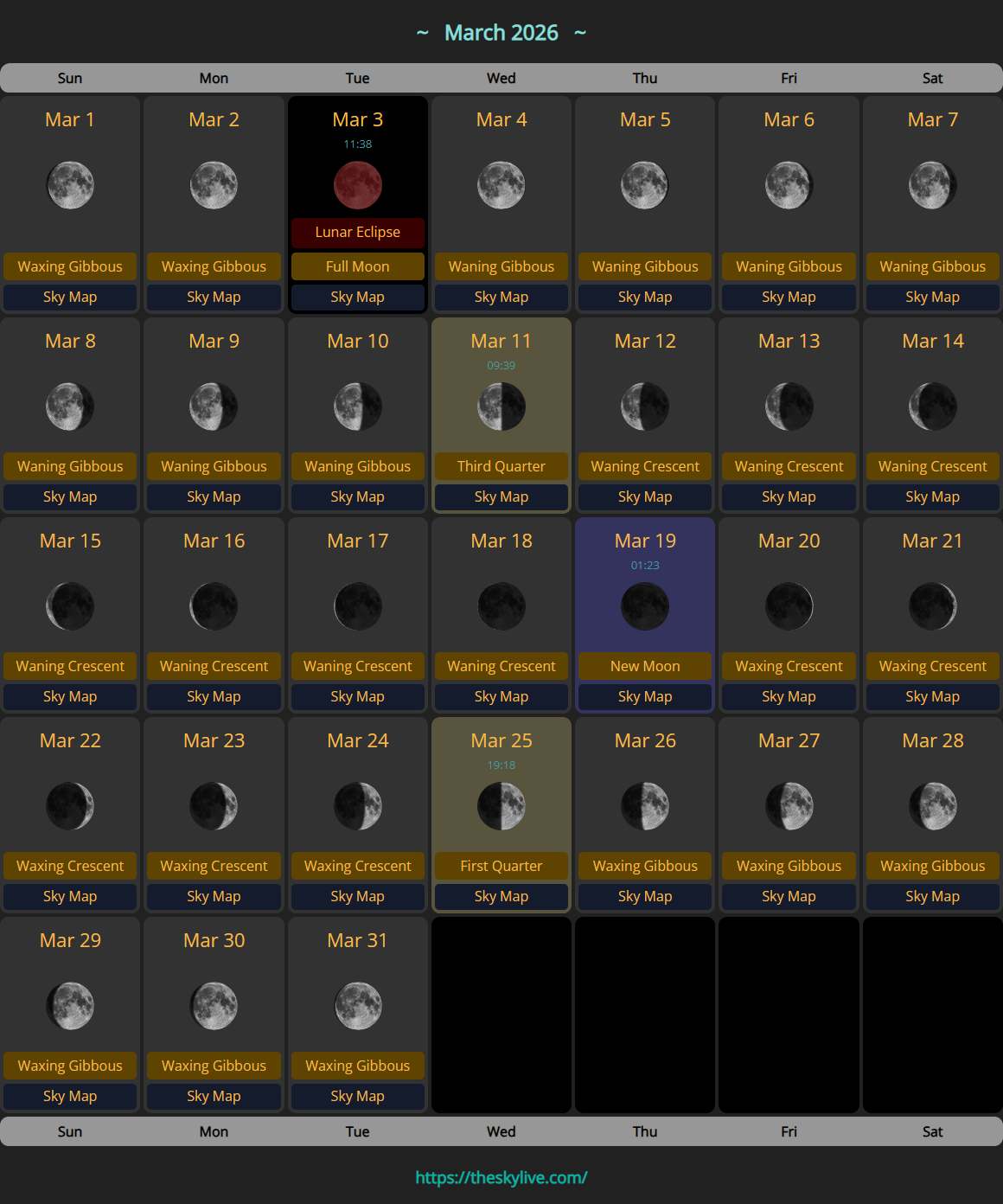
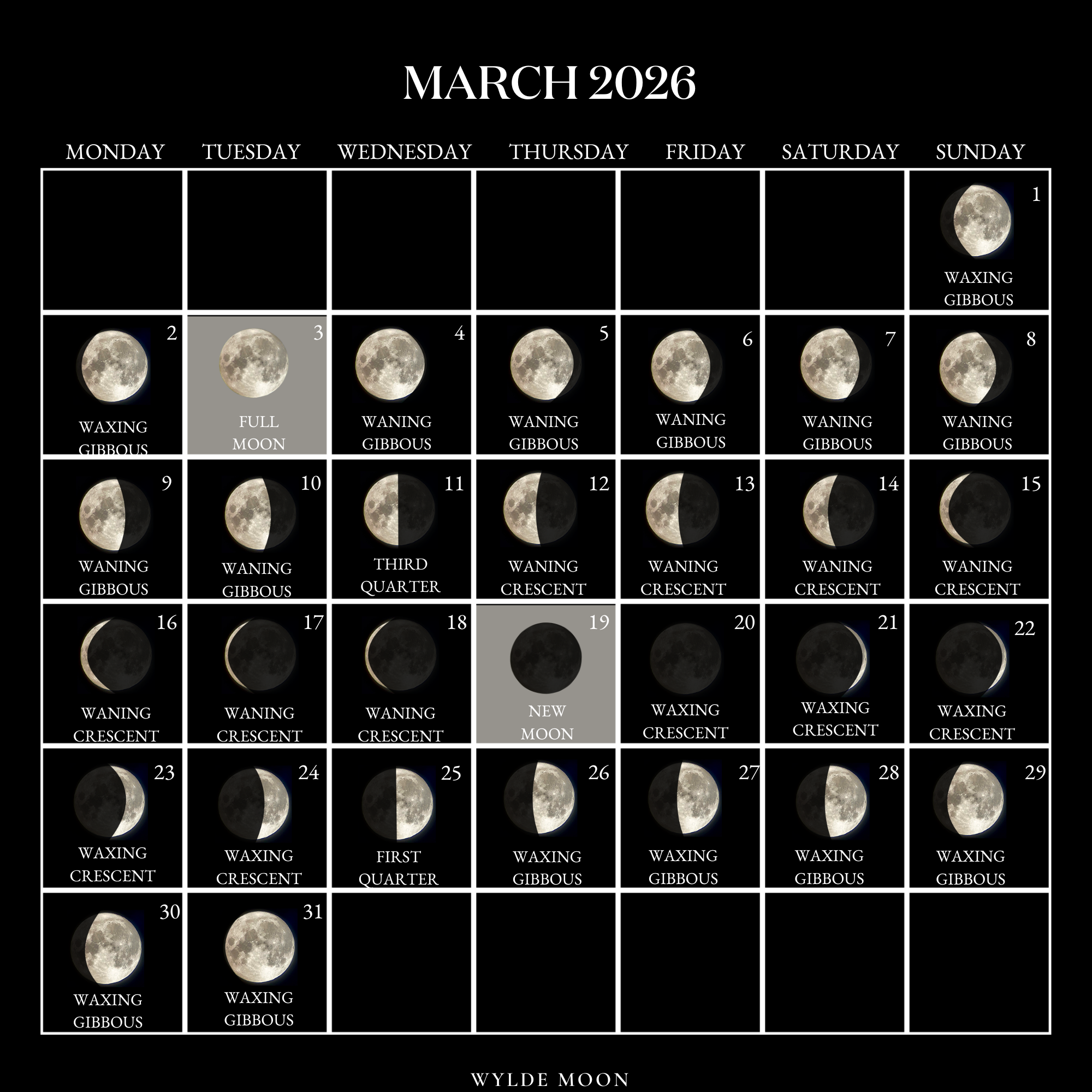
Here’s a full breakdown of the Moon’s journey through March 2026:
| Moon Phase | Date | Time (UTC) | Time (ET) | Time (CT) | Time (MT) | Time (PT) |
|---|---|---|---|---|---|---|
| First Quarter | Monday, March 9 | 00:03 AM | 07:03 PM (Mar 8) | 06:03 PM (Mar 8) | 05:03 PM (Mar 8) | 04:03 PM (Mar 8) |
| Full Moon (Worm Moon) & Total Lunar Eclipse | Tuesday, March 3 | 11:37 AM | 06:37 AM | 05:37 AM | 04:37 AM | 03:37 AM |
| Last Quarter | Wednesday, March 25 | 09:44 AM | 04:44 AM | 03:44 AM | 02:44 AM | 01:44 AM |
| New Moon | Wednesday, March 18 | 10:04 PM | 05:04 PM | 04:04 PM | 03:04 PM | 02:04 PM |
Understanding the Lunar Cycle: A Quick Refresher
The moon’s phases are a continuous cycle, each offering unique energy and visual prominence:
- New Moon: The moon is between the Earth and the Sun, making it invisible from Earth. A time for new beginnings and setting intentions.
- Waxing Crescent: A sliver of light appears, growing larger each night.
- First Quarter: Half of the moon is illuminated. A time for action and overcoming challenges.
- Waxing Gibbous: More than half of the moon is lit, growing towards full.
- Full Moon: The entire face of the moon is illuminated. A time of culmination, release, and heightened energy.
- Waning Gibbous: The illumination begins to decrease after the full moon.
- Last Quarter: The other half of the moon is illuminated. A time for evaluation and adjustment.
- Waning Crescent: A sliver of light remains, shrinking towards the new moon.
Connecting with the Moon: Rituals, Reflection, and Practical Applications
For centuries, humanity has looked to the moon for guidance, inspiration, and a sense of rhythm in life. The March 2026 Full Worm Moon, amplified by a total lunar eclipse, offers an especially potent opportunity for reflection and connection.
Harnessing Full Moon Energy
Full Moons are often associated with completion, illumination, and release. This particular Full Moon in Virgo, combined with the introspective nature of an eclipse, makes it ideal for:
- Releasing What No Longer Serves You: Write down habits, fears, or situations you wish to let go of. Visualize them dissolving under the full moon’s glow.
- Gratitude Practice: Reflect on what you’ve achieved since the last New Moon. Express thanks for your blessings.
- Healing and Cleansing: Use the powerful lunar energy for personal healing, charging crystals, or cleansing your space.
- Creative Expression: Many find their creative juices flow more freely under a full moon. Engage in art, writing, or music.
The lunar eclipse adds another layer: eclipses are often seen as cosmic resets, periods of accelerated change, or revelations. What might be illuminated for you during this intense celestial alignment?
Practical Tips for Lunar Living
Beyond the mystical, connecting with the moon can be a grounding practice in our busy lives:
- Journaling: Use the moon phases as prompts. What intentions did you set at the New Moon? What have you accomplished by the Full Moon? What are you ready to release as the Moon wanes?
- Mindful Observation: Simply step outside and observe the moon. Notice its shape, its light, how it moves across the sky. This simple act can be incredibly calming.
- Garden by the Moon (Lunar Gardening): Some gardeners believe certain phases are better for planting, harvesting, or pruning. The Worm Moon, signaling spring’s arrival, is historically linked to the start of planting season.
- Connect with Community: Many groups gather to observe full moons or eclipses. Look for local astronomy clubs or spiritual groups in your area.
The Full Moon Year Ahead: Your 2026 Lunar Calendar
The March Worm Moon is just one of many celestial spectacles awaiting us in 2026. Here’s a look at all the full moons gracing our skies throughout the year, each with its own traditional name and significance.

Every Full Moon of 2026
| Month | Date | Time (UTC) | Traditional Name |
|---|---|---|---|
| January | Saturday, Jan 3 | 11:03 AM | Wolf Moon |
| February | Sunday, Feb 1 | 11:09 PM | Snow Moon |
| March | Tuesday, Mar 3 | 11:37 AM | Worm Moon (Total Lunar Eclipse) |
| April | Thursday, Apr 2 | 03:12 AM | Pink Moon |
| May | Friday, May 1 | 06:23 PM | Flower Moon |
| May (Second Full Moon) | Sunday, May 31 | 09:45 AM | Blue Moon |
| July | Tuesday, Jul 29 | 12:00 PM | Buck Moon |
| August | Thursday, Aug 28 | 02:37 PM | Sturgeon Moon |
| September | Saturday, Sep 26 | 05:32 PM | Harvest Moon |
| October | Monday, Oct 26 | 09:00 PM | Hunter’s Moon |
| November | Wednesday, Nov 25 | 01:40 AM | Beaver Moon |
| December | Thursday, Dec 24 | 07:50 AM | Cold Moon |
Note the Blue Moon in May 2026. This occurs when there are two full moons in a single calendar month – a relatively rare event, adding another layer of intrigue to our lunar year!
Conclusion: Embrace the March 2026 Lunar Spectacle
The March 2026 Full Worm Moon is shaping up to be far more than just another date on the calendar. With its profound traditional name, its astrological alignment in Virgo, and, most notably, the incredible total lunar eclipse, it offers a unique opportunity to connect with the cosmos.
Whether you’re an avid stargazer, an astrology enthusiast, or simply someone who appreciates the wonders of nature, make sure to mark your calendars. Set your alarms, prepare your viewing spot, and get ready to witness a truly unforgettable celestial event. The Blood Moon awaits!
Frequently Asked Questions
When is the Full Moon in March 2026?
The Full Moon in March 2026, traditionally known as the Worm Moon, occurs on Tuesday, March 3, 2026, reaching its peak illumination at 11:37 AM UTC. This translates to 6:37 AM ET, 5:37 AM CT, 4:37 AM MT, and 3:37 AM PT for observers in the United States.
What is the traditional name for the March Full Moon?
The traditional name for the March Full Moon is the Worm Moon. This name, given by Native American tribes, refers to the time when the ground thaws and earthworms begin to reappear, signaling the return of birds and the onset of spring.
Will there be a lunar eclipse in March 2026?
Yes, a spectacular total lunar eclipse will coincide with the Full Moon in March 2026. This celestial event, often called a ‘Blood Moon,’ will be visible across much of North America, South America, Europe, and Africa.
What time will the lunar eclipse be visible in the USA?
The total lunar eclipse on March 3, 2026, begins its total phase at 11:15 AM UTC (6:15 AM ET, 5:15 AM CT, 4:15 AM MT, 3:15 AM PT), reaching maximum eclipse at 11:37 AM UTC. The total phase will last until 11:58 AM UTC (6:58 AM ET, 5:58 AM CT, 4:58 AM MT, 3:58 AM PT), making it an early morning event for most of the USA.
Is it safe to look at a lunar eclipse?
Absolutely! Unlike solar eclipses, which require special eye protection, lunar eclipses are completely safe to view directly with the naked eye. Binoculars or a small telescope can enhance the view of the ‘Blood Moon’ effect and lunar details.
What does the Worm Moon signify?
The Worm Moon signifies the awakening of nature after winter. It’s associated with the thawing ground, the reappearance of earthworms, and the return of spring, symbolizing renewal, rebirth, and the start of new growth cycles.
What is the astrological significance of the March 2026 Full Moon?
The March 2026 Full Moon occurs in the zodiac sign of Virgo. This alignment brings an energy of refinement, organization, and practical application. It’s a powerful time for self-improvement, releasing what no longer serves your daily routines, and focusing on health and wellness.