The Full Moon of March 2026: Your Essential Guide to a Rare Total Lunar Eclipse and Celestial Spectacle
Get ready, sky gazers! March 2026 is bringing an astronomical event you won’t want to miss. Mark your calendars for Tuesday, March 3, 2026, because not only will we witness a dazzling Full Moon, but this particular lunation will be accompanied by a spectacular Total Lunar Eclipse!
Forget just observing another Full Moon. This is a rare opportunity to see our lunar neighbor transform into a dramatic ‘Blood Moon’ as it passes through Earth’s shadow. It’s an accessible celestial show that requires no special equipment, just your eyes and a clear sky. In this comprehensive guide, we’ll dive into everything you need to know: the exact timing, what causes a total lunar eclipse, where you can see it, and how to make the most of this breathtaking event.
The March 2026 Full Moon: When and What to Expect
The Moon’s monthly cycle culminates in the Full Moon, a moment of peak illumination that has captivated humanity for millennia. But March 2026 offers something extra special.
Exact Date and Time for the Full Moon
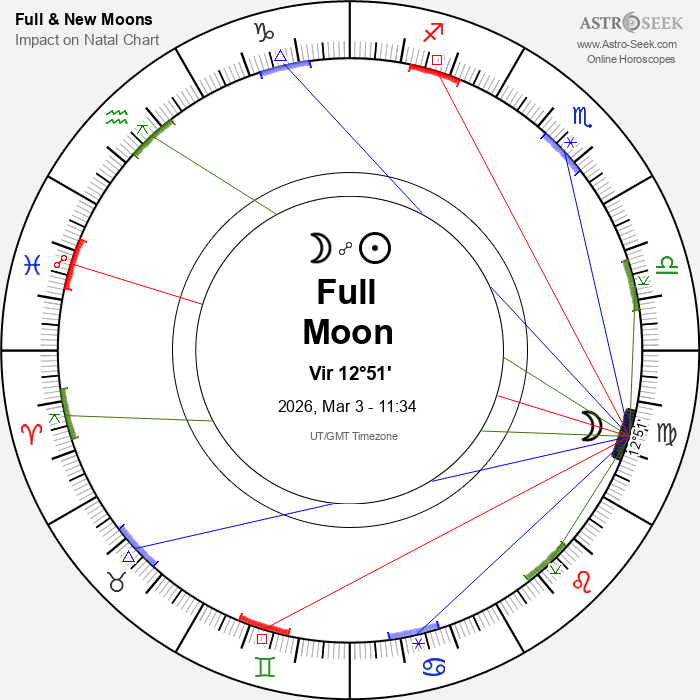
The Full Moon in March 2026 will occur on Tuesday, March 3rd. The moment of greatest illumination, also known as the peak phase, will be at 11:37 UTC (Coordinated Universal Time). For those of us in the United States, this translates to early morning hours, making it perfectly timed for viewing across many regions, especially as the lunar eclipse unfolds.

Here’s a breakdown of the Full Moon’s peak time across various U.S. time zones:
| Time Zone | Date | Local Peak Time |
|---|---|---|
| Hawaii Standard Time (HST) | Tuesday, March 3, 2026 | 1:37 AM HST |
| Alaska Standard Time (AKST) | Tuesday, March 3, 2026 | 2:37 AM AKST |
| Pacific Standard Time (PST) | Tuesday, March 3, 2026 | 3:37 AM PST |
| Mountain Standard Time (MST) | Tuesday, March 3, 2026 | 4:37 AM MST |
| Central Standard Time (CST) | Tuesday, March 3, 2026 | 5:37 AM CST |
| Eastern Standard Time (EST) | Tuesday, March 3, 2026 | 6:37 AM EST |
Remember that the Moon appears full to the naked eye for about a day before and after its exact peak, so you’ll have ample opportunity to enjoy its glow. However, to witness the Total Lunar Eclipse, timing is everything!
Unveiling the “Worm Moon” (and Other Names) for March
While the astronomical date for the March 2026 Full Moon is fixed, its traditional names vary based on cultural heritage and natural observations. The most widely recognized name for the March Full Moon in North America is the “Worm Moon.”
This name originated with Native American tribes, signaling the softening of the ground after winter’s thaw, allowing earthworms to reappear. These worms, in turn, attract robins and other birds, heralding the true arrival of spring.
Other traditional names for the March Full Moon include:
- Crow Moon: Reflecting the return of crows as winter ends.
- Sap Moon: Marking the time when maple sap begins to flow, essential for making maple syrup.
- Crust Moon: Referring to the crust that forms on top of the snow as it thaws by day and freezes by night.
- Lenten Moon: In Christian traditions, if this Full Moon falls during the Lenten season.
These names connect us to the rhythms of nature and the passage of time, adding a rich layer of cultural context to our celestial observations.
The Main Event: A Total Lunar Eclipse on March 3, 2026!
This isn’t just any Full Moon; it’s a Blood Moon in the making! The alignment of the Sun, Earth, and Moon on March 3, 2026, will create a stunning total lunar eclipse, visible to a significant portion of the world.
What is a Total Lunar Eclipse?
A total lunar eclipse occurs when the Earth positions itself directly between the Sun and the Moon. When this happens, the Earth casts its shadow across the Moon. There are two parts to Earth’s shadow:
- Penumbral Shadow: The lighter, outer part of the shadow. The Moon might appear slightly dimmed when passing through this.
- Umbral Shadow: The darker, inner part of the shadow. When the Moon is fully within the umbra, we experience a total lunar eclipse.
During totality, the Moon doesn’t completely disappear. Instead, it often takes on a dramatic reddish-orange hue. This phenomenon gives rise to the term “Blood Moon.” The color comes from sunlight filtering through Earth’s atmosphere. Just as sunsets appear red because blue light is scattered away, the redder light bends around Earth and illuminates the Moon.
Visibility: Who Will See the March 2026 Lunar Eclipse?
The total lunar eclipse on March 3, 2026, will be visible from a wide range of locations, offering a spectacular view for millions. Key regions that will experience at least part of this eclipse include:
- North America: Much of the continent will have an excellent view, especially in the western and central parts.
- South America: Many areas will witness the eclipse.
- Europe: Observers will see the eclipse, particularly in western and central Europe.
- Africa: Most of the continent will be able to view the event.
- Parts of Asia: Western parts of Asia might catch the beginning or end of the eclipse.
For those of us in the United States, the eclipse will be well-placed in the sky during the pre-dawn hours of March 3rd. While the exact timing and visibility depend on your specific location, many Americans will be able to witness the Moon turn blood-red, making for a truly memorable morning.
Key Phases and Timings of the Eclipse (March 3, 2026)
A total lunar eclipse progresses through several distinct phases. Knowing these timings will help you anticipate the spectacle and know when to look up. All times provided here are in UTC (Coordinated Universal Time) and are approximate, encouraging you to check local astronomical resources closer to the date for precise timings in your specific area.
| Eclipse Phase | Approximate UTC Time (March 3, 2026) | What You’ll See |
|---|---|---|
| Penumbral Eclipse Begins | 08:41 UTC | The Moon enters Earth’s faint outer shadow. A subtle dimming, often hard to notice. |
| Partial Eclipse Begins | 09:44 UTC | The Moon enters Earth’s dark inner shadow (umbra). A noticeable ‘bite’ appears on the Moon’s edge. |
| Total Eclipse Begins | 10:48 UTC | The entire Moon is now within the umbra, taking on its dramatic reddish hue – the ‘Blood Moon.’ |
| Maximum Eclipse (Full Moon Peak) | 11:37 UTC | The deepest point of the eclipse, with the Moon appearing its most intensely red. |
| Total Eclipse Ends | 12:26 UTC | The Moon begins to emerge from the umbra, and the reddish color starts to recede. |
| Partial Eclipse Ends | 13:30 UTC | The Moon completely leaves the umbra, but is still partially in the penumbra. |
| Penumbral Eclipse Ends | 14:33 UTC | The Moon fully exits Earth’s shadow, returning to its normal brightness. |
Remember to convert these UTC times to your local time zone to plan your viewing experience. For example, for Eastern Standard Time (EST), subtract 5 hours from UTC.
How to Observe the Total Lunar Eclipse Safely
One of the best things about a lunar eclipse is that it’s completely safe to watch with the naked eye! Unlike solar eclipses, you don’t need any special filters or protective eyewear. So, relax and enjoy the show!
Here are a few tips to enhance your viewing experience:
- Find a Clear View: Head to an open area away from tall buildings and trees that might obstruct your view of the Moon.
- Minimize Light Pollution: The darker your surroundings, the more vivid the eclipse will appear. Try to get away from city lights if possible.
- Dress Warmly: Since the eclipse occurs in the early morning hours, especially in the USA, it will likely be chilly. Bundle up!
- Bring Binoculars or a Telescope: While not necessary, binoculars can offer a magnified view, allowing you to appreciate the subtle colors and textures of the Moon’s surface as it darkens and reddens. A small telescope will provide an even more detailed look.
- Set an Alarm: Don’t miss the peak! Given the early morning timing, setting an alarm is crucial.
- Gather Your Loved Ones: This is a fantastic opportunity to share a memorable astronomical event with family and friends.
- Photography: If you’re into astrophotography, a lunar eclipse is a rewarding subject. You’ll need a camera with manual settings and a sturdy tripod.
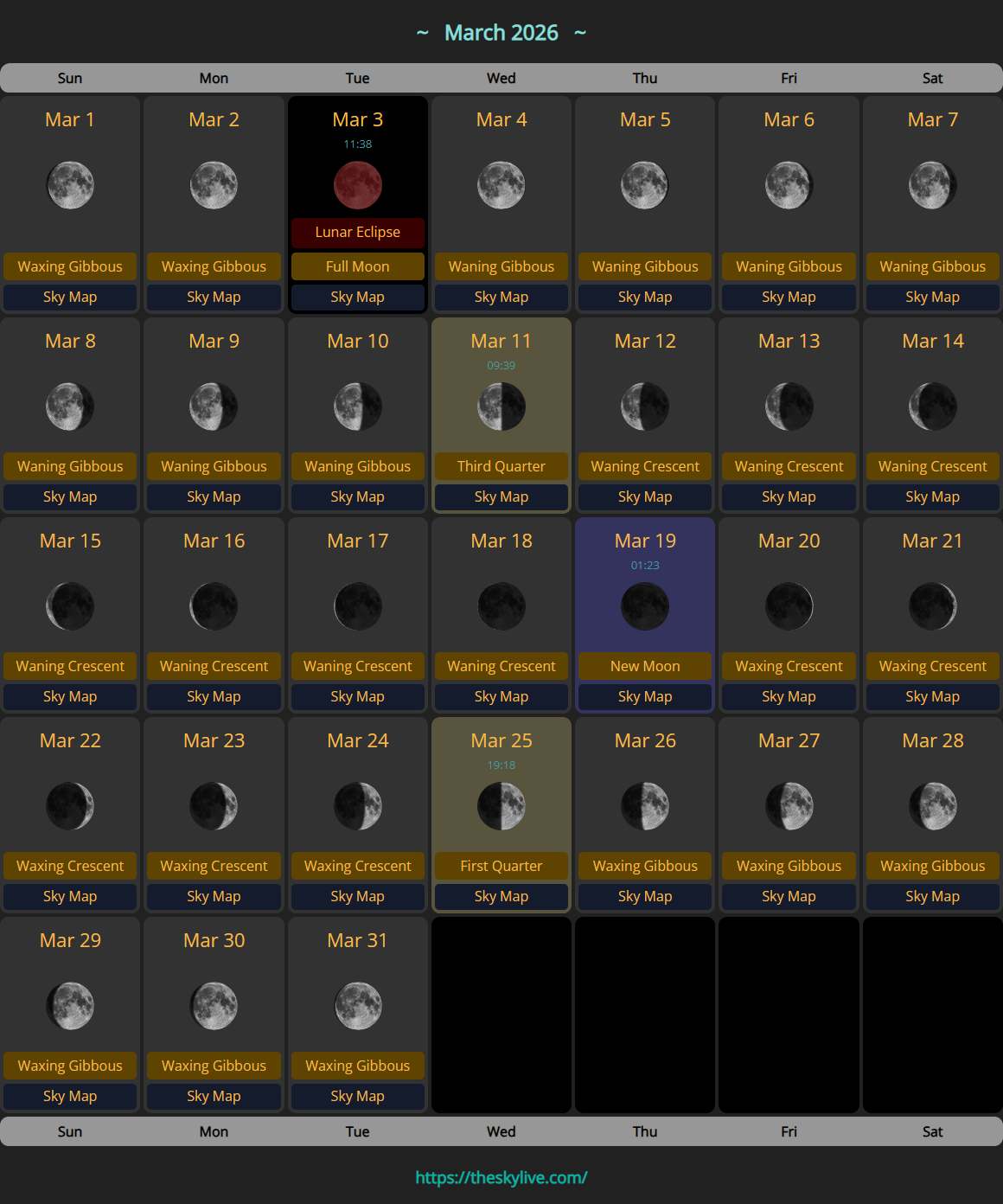
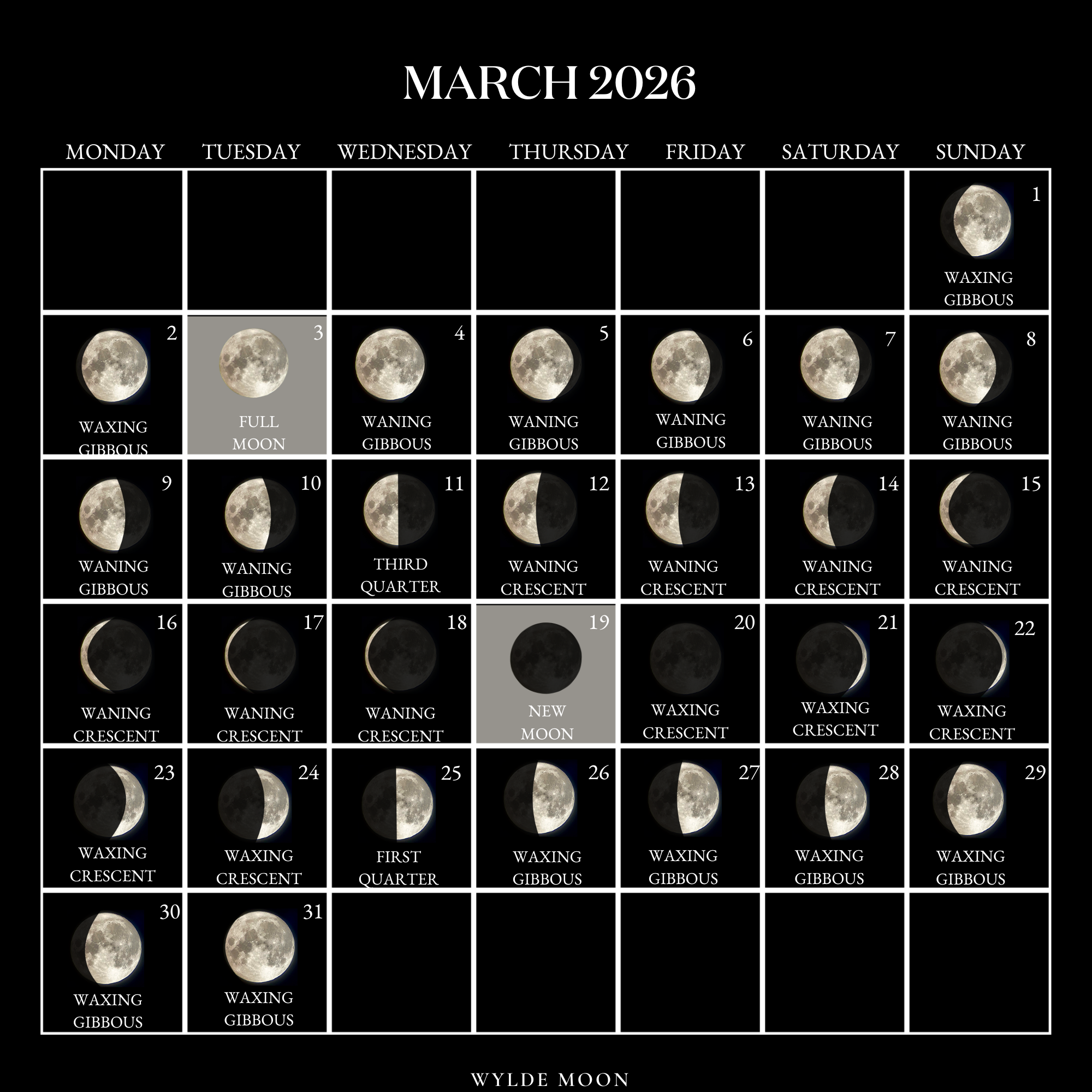
March 2026 Moon Phases at a Glance
Beyond the magnificent Full Moon and eclipse, the Moon undergoes its entire cycle throughout March. Understanding these phases can help you connect more deeply with our celestial companion.
Comprehensive Moon Phases Calendar for March 2026
Here’s a full breakdown of all the primary Moon phases for March 2026, including their approximate dates and times in UTC. Remember, these times allow for easy conversion to your local time zone.
| Moon Phase | Date | Approximate UTC Time | Illumination |
|---|---|---|---|
| Full Moon (Total Lunar Eclipse) | Tuesday, March 3 | 11:37 UTC | 100% |
| Last Quarter Moon | Wednesday, March 11 | 10:04 UTC | 50% |
| New Moon | Thursday, March 19 | 00:32 UTC | 0% |
| First Quarter Moon | Thursday, March 27 | 14:21 UTC | 50% |
Understanding the Lunar Cycle: Waxing and Waning
The Moon doesn’t actually change shape; its phases are simply the different amounts of its sunlit surface visible from Earth. This ever-changing appearance is known as the lunar cycle, lasting approximately 29.5 days.
- New Moon: The start of the cycle, when the Moon is between the Earth and the Sun, making its sunlit side face away from us. It’s largely invisible.
- Waxing Phases: After the New Moon, the illuminated portion we see grows larger each night. This includes the Waxing Crescent and First Quarter Moon (half-lit on the right for Northern Hemisphere observers).
- Full Moon: The entire face of the Moon is illuminated by the Sun, appearing as a perfect circle. This is when the Moon is opposite the Sun, with Earth in between.
- Waning Phases: After the Full Moon, the illuminated portion appears to shrink each night. This includes the Waning Gibbous and Last Quarter Moon (half-lit on the left for Northern Hemisphere observers).
This continuous dance of light and shadow is a constant reminder of the intricate mechanics of our solar system.
Beyond the Stargazing: Cultural Significance & Impact
For centuries, the Moon has been more than just a light in the night sky. It has influenced everything from tides to folklore, and even our own perceptions.
How Full Moons Influence Tides, Wildlife, and Human Moods
- Tides: The gravitational pull of the Moon is the primary driver of Earth’s tides. During a Full Moon (and New Moon), the Sun, Earth, and Moon are aligned, combining their gravitational forces to create stronger-than-average “spring tides” (higher high tides and lower low tides).
- Wildlife: Many species exhibit behaviors tied to the lunar cycle. Nocturnal animals often become more active during Full Moons due to increased visibility. Marine life, especially, times its breeding and feeding patterns with the Moon’s phases and associated tides.
- Human Moods & Folklore: While scientific evidence for a direct impact on human behavior (beyond light disruption) is limited, the Full Moon has a powerful place in human culture. Myths and legends often associate it with heightened emotions, strange occurrences, and transformations. Many people report feeling more energized or having disrupted sleep during a Full Moon, though this could be psychological or due to the increased light.
Connecting with the Moon: Activities for March 2026
This March, with the added wonder of a total lunar eclipse, is an ideal time to deepen your connection with the cosmos:

- Moon Gazing Party: Invite friends and family to watch the eclipse together. Share blankets, hot drinks, and binoculars for an unforgettable experience.
- Eclipse Photography: Capture the changing colors of the Blood Moon. Even with a smartphone and a tripod, you can get some impressive shots.
- Journaling and Reflection: Use the powerful energy of the Full Moon, especially one accompanied by an eclipse, for personal reflection. What cycles are ending in your life? What new intentions are you setting?
- Storytelling: Research and share moon myths and legends from different cultures. The Moon has inspired countless stories – add yours to the tradition!
- Nature Walk: Take a walk under the Full Moon’s glow (or during the eclipse for a unique ambiance) and observe how the world around you seems different.
What’s Next? Looking Ahead to April 2026’s Pink Moon
While the March 2026 Full Moon and its accompanying total lunar eclipse will undoubtedly be a highlight, the celestial show never truly ends. As we move into April, another beautiful Full Moon awaits us: the Pink Moon. This Full Moon, typically occurring in April, is named after the moss pink herb (Phlox subulata), one of the first widespread flowers of spring. So, after you’ve savored the spectacle of March, keep your eyes on the skies for the vibrant return of spring’s lunar beauty.
The cosmos continues to offer endless wonder. Make sure to step outside, look up, and be a part of it!
Frequently Asked Questions
When is the Full Moon in March 2026?
The Full Moon in March 2026 occurs on Tuesday, March 3rd, with its peak illumination at 11:37 UTC (Coordinated Universal Time). This translates to early morning hours across the United States, for example, 6:37 AM EST or 3:37 AM PST.
Will there be a lunar eclipse in March 2026?
Yes, March 2026 will feature a spectacular Total Lunar Eclipse! This rare event will coincide with the Full Moon on March 3rd, offering a chance to see the Moon turn a dramatic reddish-orange hue, often called a ‘Blood Moon’.
What is the traditional name for the March Full Moon?
The most common traditional name for the March Full Moon is the ‘Worm Moon.’ This name reflects the softening of the ground after winter, allowing earthworms to reappear and signaling the return of spring.
Where will the March 2026 Total Lunar Eclipse be visible?
The Total Lunar Eclipse on March 3, 2026, will be visible from a wide range of regions, including much of North and South America, Europe, Africa, and parts of Asia. Most of the United States will have excellent visibility during the pre-dawn hours.
Do I need special equipment to view the Total Lunar Eclipse?
No, you do not need any special equipment to view a total lunar eclipse. It is completely safe to observe with the naked eye. However, binoculars or a small telescope can enhance the view and allow you to appreciate more details and the Moon’s changing colors.
What are the other Moon phases for March 2026?
In addition to the Full Moon (and Total Lunar Eclipse) on March 3rd, March 2026 will also feature the Last Quarter Moon on March 11th, the New Moon on March 19th, and the First Quarter Moon on March 27th.